
Artificial Intelligence is transforming how businesses work, but one challenge continues to limit many AI applications—accuracy. Large Language Models (LLMs) such as ChatGPT, Gemini, and Claude are incredibly powerful, but they often rely on pre-trained knowledge that may be outdated or incomplete. This can lead to incorrect responses, commonly known as AI hallucinations.
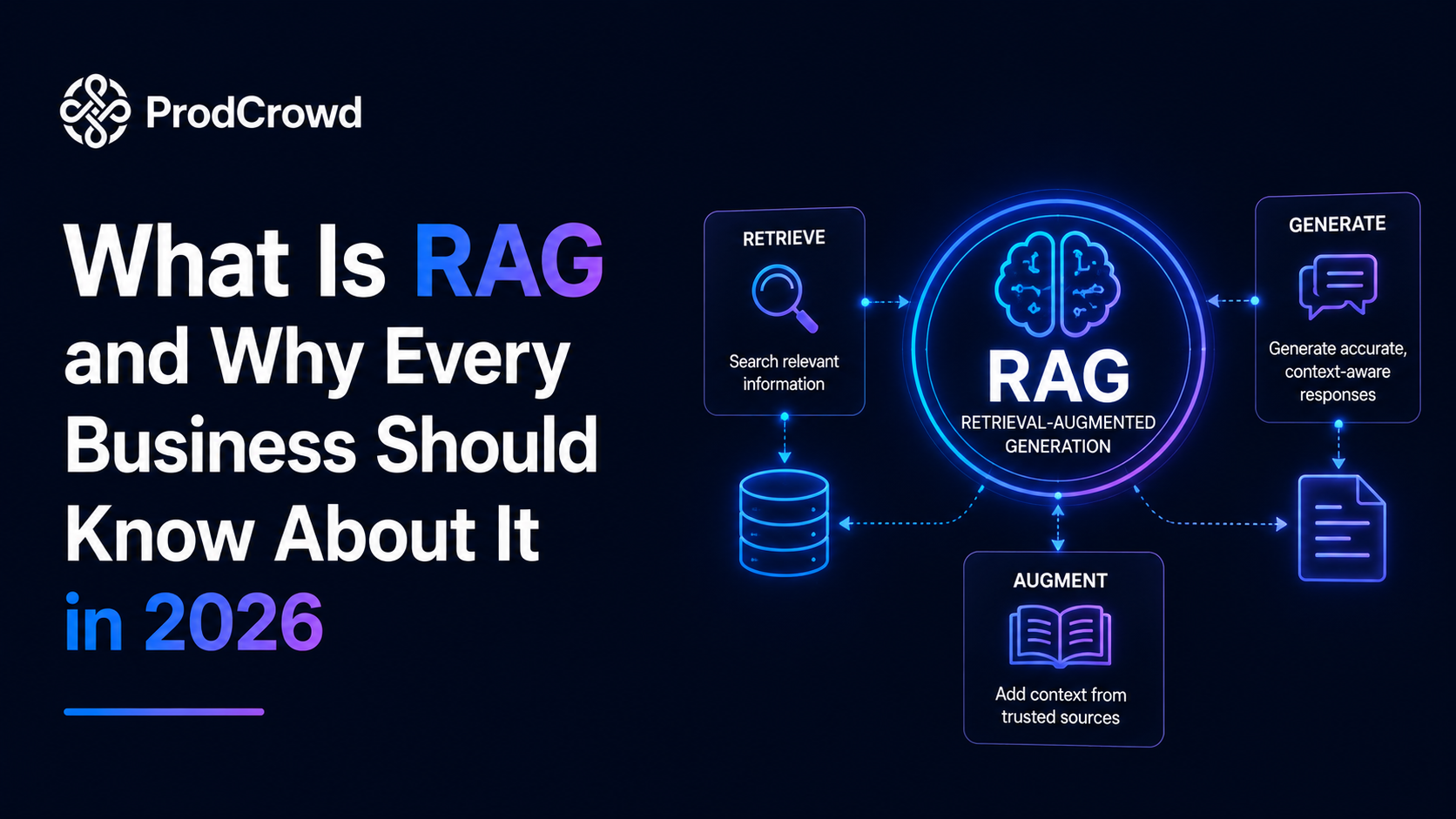
To overcome this limitation, organizations are adopting Retrieval Augmented Generation (RAG). RAG combines the power of generative AI with real-time access to trusted business data, enabling AI systems to provide accurate, context-aware, and up-to-date responses.
Whether you’re a startup building an AI-powered product or an enterprise modernizing operations, understanding RAG for business is essential for creating secure, reliable, and intelligent AI solutions.
What Is Retrieval-Augmented Generation (RAG)?
Retrieval-Augmented Generation (RAG) is an AI architecture that improves the quality of AI-generated responses by retrieving relevant information from trusted data sources before generating an answer.
Instead of relying only on what the AI model learned during training, a RAG system searches your organization’s documents, databases, or knowledge base and uses that information to produce a more accurate response.
Think of it as giving your AI assistant access to your company’s internal knowledge instead of asking it to rely solely on memory.
Why Traditional AI Models Have Limitations
Large Language Models are trained on enormous datasets, but they have several limitations:
- Knowledge becomes outdated after training.
- They cannot automatically access your private business documents.
- They may generate confident but incorrect answers.
- They lack awareness of company-specific policies and procedures.
For businesses handling sensitive information or regulated processes, these limitations can create significant risks.
How RAG Works
A RAG system follows a simple but powerful process.
Step 1: User Asks a Question
Example:
“What is our company’s refund policy?”
Step 2: Information Retrieval
The system searches trusted business sources such as:
- Internal documents
- Knowledge bases
- Product manuals
- CRM systems
- SharePoint
- Google Drive
- Confluence
- Databases
Step 3: Relevant Information Is Retrieved
Only the most relevant content is selected.
Step 4: AI Generates the Response
The Large Language Model combines the retrieved information with its reasoning capabilities to generate an accurate, context-aware answer.
Step 5: User Receives Reliable Results
The response is based on verified business knowledge rather than general internet knowledge.
Why Businesses Are Investing in RAG
Organizations increasingly need AI systems they can trust.
RAG enables businesses to:
- Reduce AI hallucinations
- Improve response accuracy
- Protect sensitive information
- Deliver real-time answers
- Scale internal knowledge management
- Improve employee productivity
This makes RAG one of the most important technologies powering enterprise AI in 2026.
Key Benefits of RAG for Business
Higher Accuracy
RAG retrieves information from trusted business sources before generating responses.
This dramatically reduces misinformation.
Real-Time Knowledge
Unlike static AI models, RAG uses current company documents.
Employees always receive the latest information.
Better Data Security
Enterprise RAG systems can securely access internal documents without exposing confidential information to public AI models.
Reduced AI Hallucinations
Since responses are grounded in verified content, AI is far less likely to generate inaccurate answers.
Faster Employee Productivity
Employees spend less time searching for documents and more time completing meaningful work.
Improved Customer Support
Support teams receive instant access to product documentation, policies, and troubleshooting guides.
Customers receive faster and more accurate answers.
Business Use Cases for RAG
Enterprise Knowledge Management
Employees can instantly search company policies, SOPs, contracts, and documentation using natural language.
Customer Support
AI assistants retrieve accurate product information before responding to customer inquiries.
Sales Enablement
Sales teams can quickly access pricing documents, proposals, case studies, and competitive insights.
HR and Employee Support
Employees can ask questions about:
- Leave policies
- Benefits
- Onboarding
- Compliance
- Internal procedures
Legal Teams
RAG helps legal professionals search contracts, regulations, and internal policies more efficiently.
Healthcare
Healthcare organizations use RAG to retrieve clinical guidelines, treatment protocols, and operational documentation while maintaining compliance.
Manufacturing
Manufacturers use RAG for:
- Equipment manuals
- Maintenance procedures
- Safety documentation
- Production workflows
RAG vs Traditional Chatbots
| Feature | Traditional Chatbot | RAG-Powered AI |
| Uses Company Documents | No | Yes |
| Real-Time Information | No | Yes |
| Response Accuracy | Moderate | High |
| AI Hallucinations | Higher Risk | Significantly Reduced |
| Enterprise Knowledge Access | Limited | Extensive |
| Business Integration | Basic | Advanced |
For enterprises, RAG offers a much more reliable and scalable solution than standalone chatbots.
RAG vs Fine-Tuning
Businesses often ask whether they should use RAG or fine-tuning.
| RAG | Fine-Tuning |
| Retrieves live information | Changes the AI model itself |
| Easier to update | Requires retraining |
| Best for frequently changing data | Best for specialized behaviors |
| Lower maintenance | Higher maintenance |
| Faster implementation | More complex deployment |
In many cases, organizations combine both approaches for maximum performance.
Challenges of Implementing RAG
Although RAG offers significant advantages, successful implementation requires careful planning.
Common challenges include:
Data Quality
Poor or outdated documentation leads to poor AI responses.
Security
Sensitive business data must be protected through encryption, access controls, and governance.
Integration
RAG systems should connect seamlessly with existing enterprise applications.
Content Management
Organizations should maintain accurate and well-structured knowledge repositories.
Best Practices for Enterprise RAG
To maximize business value:
- Organize company knowledge before deployment.
- Use secure vector databases for document retrieval.
- Integrate with CRM, ERP, and knowledge management systems.
- Continuously update business documentation.
- Monitor AI performance and user feedback.
- Implement role-based access controls.
The Future of RAG
RAG is evolving rapidly alongside Generative AI.
Emerging trends include:
AI Agents with RAG
Autonomous AI agents using enterprise knowledge to complete business tasks.
Multimodal RAG
Retrieving information from documents, images, videos, and audio.
Personalized Enterprise AI
Delivering role-specific responses based on employee permissions.
Real-Time Business Intelligence
Combining live business data with AI-generated insights.
Industry-Specific RAG Solutions
Custom AI assistants for healthcare, finance, legal, manufacturing, and retail.
Why Businesses Should Adopt RAG Now
Organizations investing in RAG gain several competitive advantages:
- More accurate AI responses
- Better customer experiences
- Improved employee productivity
- Reduced operational costs
- Stronger data governance
- Greater confidence in AI-driven decisions
As enterprise AI adoption accelerates, RAG is becoming a foundational component of modern AI architectures.
Why Choose ProdCrowd?
At ProdCrowd, we help businesses build secure, scalable, and intelligent AI solutions powered by Retrieval-Augmented Generation.
Our AI expertise includes:
- Enterprise RAG Solutions
- Custom Generative AI Development
- AI Knowledge Assistants
- Enterprise Search Systems
- AI Workflow Automation
- AI Consulting
- Business Process Automation
- AI Agent Development
Whether you’re building an internal knowledge assistant, customer support chatbot, or enterprise AI platform, ProdCrowd delivers tailored solutions that integrate seamlessly with your business systems.
People Also Search For
- What is Retrieval-Augmented Generation?
- RAG vs Fine-Tuning
- Enterprise AI architecture
- AI knowledge retrieval
- Vector databases for AI
- Enterprise AI search
- AI document retrieval
- Business AI automation
- Generative AI implementation
- AI consulting services
People Also Ask
What is RAG in Artificial Intelligence?
Retrieval-Augmented Generation (RAG) is an AI framework that retrieves relevant information from trusted data sources before generating a response, making AI outputs more accurate and reliable.
Why is RAG important for businesses?
RAG helps businesses reduce AI hallucinations, improve response accuracy, access internal knowledge securely, and enhance employee and customer experiences.
What is the difference between RAG and ChatGPT?
ChatGPT primarily relies on its trained knowledge, while a RAG system retrieves real-time information from business documents and databases before generating responses.
Does RAG improve AI accuracy?
Yes. By grounding responses in trusted, up-to-date information, RAG significantly improves the accuracy and reliability of AI-generated content.
Which industries benefit from RAG?
Healthcare, finance, manufacturing, legal, retail, education, SaaS, and customer support organizations all benefit from RAG-powered AI.
FAQ’s
Is RAG suitable for small businesses?
Yes. Cloud-based RAG solutions make advanced AI capabilities accessible to startups and small businesses without requiring large infrastructure investments.
Can RAG integrate with Microsoft SharePoint or Google Drive?
Yes. Modern RAG platforms integrate with popular document management systems, cloud storage, and enterprise collaboration tools.
Does RAG replace Large Language Models?
No. RAG enhances LLMs by providing them with real-time, relevant information from trusted sources before generating responses.
Is RAG secure for enterprise environments?
Yes. Enterprise RAG solutions include encryption, authentication, access controls, and compliance features to protect sensitive business information.
How long does it take to implement a RAG solution?
Implementation timelines depend on the complexity of your data sources and integrations. A basic proof of concept may take a few weeks, while a full enterprise deployment can take several months.
Conclusion
Retrieval-Augmented Generation (RAG) is quickly becoming the backbone of enterprise AI because it combines the creativity of generative models with the accuracy of trusted business knowledge. Instead of relying solely on pre-trained data, RAG enables AI to deliver context-aware, reliable, and secure responses that businesses can confidently use in real-world operations.
From improving customer support and employee productivity to powering AI agents and enterprise search, RAG offers organizations a practical path to smarter automation and better decision-making. As AI adoption continues to grow in 2026 and beyond, businesses that invest in RAG-powered solutions will be better positioned to innovate, scale, and maintain a competitive edge.
If your organization is ready to build AI systems that are accurate, secure, and aligned with your business goals, ProdCrowd can help you design and implement enterprise-grade RAG solutions tailored to your needs.