
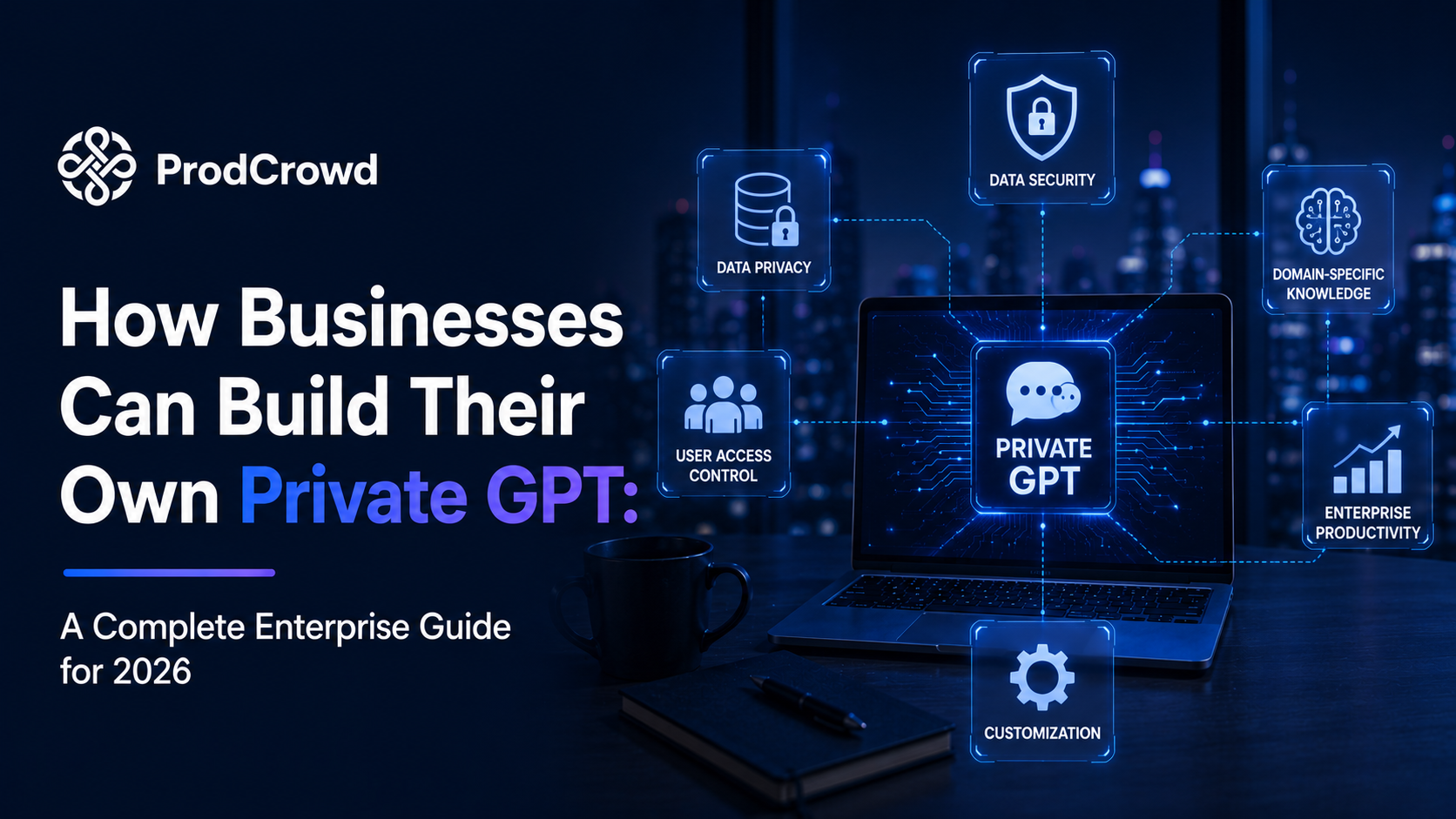
Generative AI has transformed how organizations search information, automate workflows, support employees, and improve customer experiences. While public AI tools are powerful, many businesses hesitate to use them for sensitive operations because of data privacy, compliance, and intellectual property concerns.
That’s where a private GPT for business becomes a game-changer.
Unlike public AI platforms, a private GPT operates within your organization’s secure environment, allowing employees to access company knowledge without exposing confidential information. It can answer questions using internal documents, automate repetitive tasks, assist customer support teams, and improve decision-making while maintaining enterprise-grade security.
This guide explains what a Private GPT is, how it works, its benefits, implementation process, security considerations, and best practices for enterprise deployment.
What Is a Private GPT?
A Private GPT is an AI-powered assistant that runs using your organization’s approved infrastructure and securely accesses your internal knowledge.
Instead of relying only on public internet data, it can retrieve answers from:
- Company policies
- Standard operating procedures (SOPs)
- Product documentation
- Employee handbooks
- Knowledge bases
- CRM records
- Internal databases
- Technical manuals
- Support documentation
- Project documentation
Employees receive fast, context-aware answers without manually searching multiple systems.
Why Businesses Need a Private GPT
Public AI tools often cannot access internal business knowledge securely.
A private AI assistant solves this challenge by:
- Protecting confidential information
- Improving employee productivity
- Reducing manual knowledge searches
- Supporting faster decision-making
- Delivering accurate internal answers
- Maintaining regulatory compliance
It becomes a centralized knowledge hub for the organization.
Benefits of Building a Private GPT
Enhanced Data Security
Sensitive company information remains within approved environments instead of being exposed to public AI services.
Faster Employee Productivity
Employees can ask natural language questions like:
- “Show our latest HR leave policy.”
- “Summarize the Q2 sales report.”
- “What is our customer refund process?”
- “Find the latest cybersecurity policy.”
Instead of searching multiple documents, answers are delivered instantly.
Improved Customer Support
Support teams can quickly retrieve:
- Product specifications
- Troubleshooting guides
- Warranty policies
- Technical documentation
This reduces response times and improves customer satisfaction.
Consistent Business Knowledge
Everyone receives information from the same approved sources, reducing inconsistencies and outdated responses.
Scalable Enterprise Automation
Private GPTs can automate:
- Internal documentation
- Employee onboarding
- IT help desks
- HR support
- Sales enablement
- Procurement workflows
- Knowledge management
Automation increases operational efficiency across departments.
How Does a Private GPT Work?
A modern enterprise AI chatbot typically combines several components:
Large Language Model (LLM)
The LLM generates natural language responses.
Organizations may choose:
- Hosted enterprise models
- Open-source models
- Private cloud deployments
The model acts as the reasoning engine.
Retrieval-Augmented Generation (RAG)
Rather than relying only on pre-trained knowledge, RAG retrieves relevant information from company documents before generating a response.
Benefits include:
- More accurate answers
- Current information
- Reduced hallucinations
- Better traceability
RAG is a key capability for enterprise AI.
Vector Database
Business documents are converted into embeddings and stored in a vector database.
When users ask questions, the system retrieves the most relevant information before generating a response.
Enterprise Integrations
A Private GPT can securely connect with:
- Microsoft 365
- Google Workspace
- SharePoint
- Salesforce
- HubSpot
- Confluence
- Slack
- Jira
- ERP systems
- CRM platforms
These integrations make AI more useful in daily workflows.
Step-by-Step Guide to Building a Private GPT
Step 1: Define Business Objectives
Identify the problems AI should solve.
Examples:
- Employee knowledge search
- Customer support automation
- IT help desk
- Sales assistance
- HR onboarding
- Internal documentation
Clear objectives guide implementation.
Step 2: Identify Data Sources
Gather trusted business knowledge, including:
- PDFs
- Word documents
- Internal wikis
- SOPs
- Product documentation
- Databases
- Knowledge bases
- Training materials
Only approved data should be indexed.
Step 3: Choose the Right AI Model
Consider:
- Accuracy
- Cost
- Security
- Performance
- Customization
- Deployment options
Model selection depends on business requirements and compliance needs.
Step 4: Implement RAG
A Retrieval-Augmented Generation architecture enables the AI to retrieve the latest information before generating responses.
This improves:
- Accuracy
- Transparency
- Reliability
- Business relevance
Step 5: Secure the Platform
Implement:
- Role-Based Access Control (RBAC)
- Multi-Factor Authentication (MFA)
- Encryption
- Audit logging
- API security
- Network protection
Security should be integrated from day one.
Step 6: Test and Optimize
Evaluate:
- Answer quality
- Retrieval accuracy
- Response speed
- User satisfaction
- Security controls
Continuous optimization improves adoption.
Security Best Practices
A secure Private GPT should include:
- Data encryption
- Access controls
- Identity management
- Audit logs
- Secure APIs
- Compliance monitoring
- Prompt filtering
- Regular security assessments
Security is essential for enterprise deployment.
Industries Using Private GPTs
Private GPT solutions are delivering value across many sectors:
Healthcare
- Clinical documentation
- Medical knowledge search
- Internal policies
Financial Services
- Compliance support
- Investment research
- Customer service
Manufacturing
- Equipment manuals
- Maintenance procedures
- Quality documentation
Legal
- Contract search
- Legal research
- Case summaries
Retail
- Product information
- Inventory support
- Customer assistance
Enterprise SaaS
- Technical documentation
- Developer support
- Customer onboarding
Common Challenges
Businesses often encounter:
- Poor data quality
- Disconnected knowledge sources
- Weak governance
- Security concerns
- User adoption issues
- Hallucinated responses
- Limited integrations
A structured AI strategy helps overcome these challenges.
Best Practices for Long-Term Success
To maximize ROI:
- Start with one department.
- Build high-quality knowledge bases.
- Keep documents updated.
- Monitor AI performance.
- Train employees.
- Continuously improve prompts.
- Expand integrations gradually.
- Maintain governance policies.
Successful AI adoption is an ongoing process.
Future of Private GPTs
Enterprise AI is rapidly evolving with:
- AI Agents
- Autonomous workflows
- Multimodal AI
- Voice-enabled assistants
- Secure enterprise copilots
- Department-specific GPTs
- AI-powered knowledge management
- Personalized employee assistants
Private GPTs are becoming the foundation of modern digital workplaces.
Why Choose ProdCrowd?
At ProdCrowd, we help businesses design, develop, and deploy secure AI solutions tailored to enterprise needs.
Our AI services include:
- Private GPT Development
- Enterprise AI Consulting
- AI Strategy & Roadmaps
- Retrieval-Augmented Generation (RAG)
- AI Agents
- Custom AI Applications
- Workflow Automation
- AI Security & Governance
- Enterprise Integrations
- Ongoing AI Optimization
Whether you’re building an internal knowledge assistant or a customer-facing enterprise chatbot, our team delivers secure, scalable AI solutions that align with your business goals.
People Also Search For
- Private GPT for enterprise
- Enterprise AI chatbot
- Internal AI assistant
- AI knowledge management
- RAG architecture
- Custom GPT development
- AI agents for business
- Enterprise generative AI
- Secure AI deployment
- AI automation platform
People Also Ask
What is a Private GPT?
A Private GPT is an AI assistant that securely accesses an organization’s internal knowledge while keeping business data protected within approved infrastructure.
Why should businesses build a Private GPT?
A Private GPT improves productivity, protects sensitive information, centralizes knowledge, supports employees, and enables secure AI adoption across the organization.
What is RAG in a Private GPT?
Retrieval-Augmented Generation (RAG) retrieves relevant company information before generating responses, making answers more accurate, current, and trustworthy.
Is a Private GPT more secure than public AI tools?
When properly implemented with access controls, encryption, governance, and secure infrastructure, a Private GPT offers greater control over sensitive business data than many public AI services.
Which industries benefit most from Private GPTs?
Healthcare, finance, manufacturing, legal services, retail, technology, education, and enterprise SaaS organizations commonly use Private GPTs to improve knowledge management and operational efficiency.
Frequently Asked Questions
How long does it take to build a Private GPT?
The timeline depends on the project’s complexity, data sources, integrations, and security requirements. Many organizations begin with a pilot deployment before expanding across departments.
Can a Private GPT integrate with existing business software?
Yes. Private GPTs can connect with document management systems, CRMs, ERPs, collaboration platforms, and other enterprise applications to deliver context-aware responses.
Does a Private GPT replace employees?
No. A Private GPT is designed to assist employees by automating repetitive tasks, surfacing relevant information, and accelerating decision-making while keeping people involved in critical business processes.
How do businesses keep a Private GPT up to date?
Organizations should regularly update indexed documents, monitor system performance, review user feedback, and refresh integrations to ensure the assistant provides accurate and relevant responses.
Why partner with ProdCrowd for Private GPT development?
ProdCrowd combines expertise in enterprise AI, RAG architecture, workflow automation, security, and governance to build scalable Private GPT solutions that integrate seamlessly with existing business systems.
Conclusion
As organizations embrace AI, protecting business knowledge has become just as important as improving productivity. A private GPT for business enables companies to harness the power of generative AI while maintaining control over sensitive data, meeting compliance requirements, and delivering accurate, context-aware assistance to employees and customers.
By combining secure infrastructure, Retrieval-Augmented Generation (RAG), enterprise integrations, and strong governance, businesses can create a reliable enterprise AI chatbot that becomes a valuable part of everyday operations. Whether your goal is to streamline internal workflows, improve customer support, or empower teams with instant access to organizational knowledge, a Private GPT provides a scalable and future-ready solution.
If you’re ready to build a secure private AI assistant tailored to your organization’s needs, ProdCrowd can help you design, deploy, and optimize an enterprise-grade AI solution that drives measurable business value while keeping your data protected.