
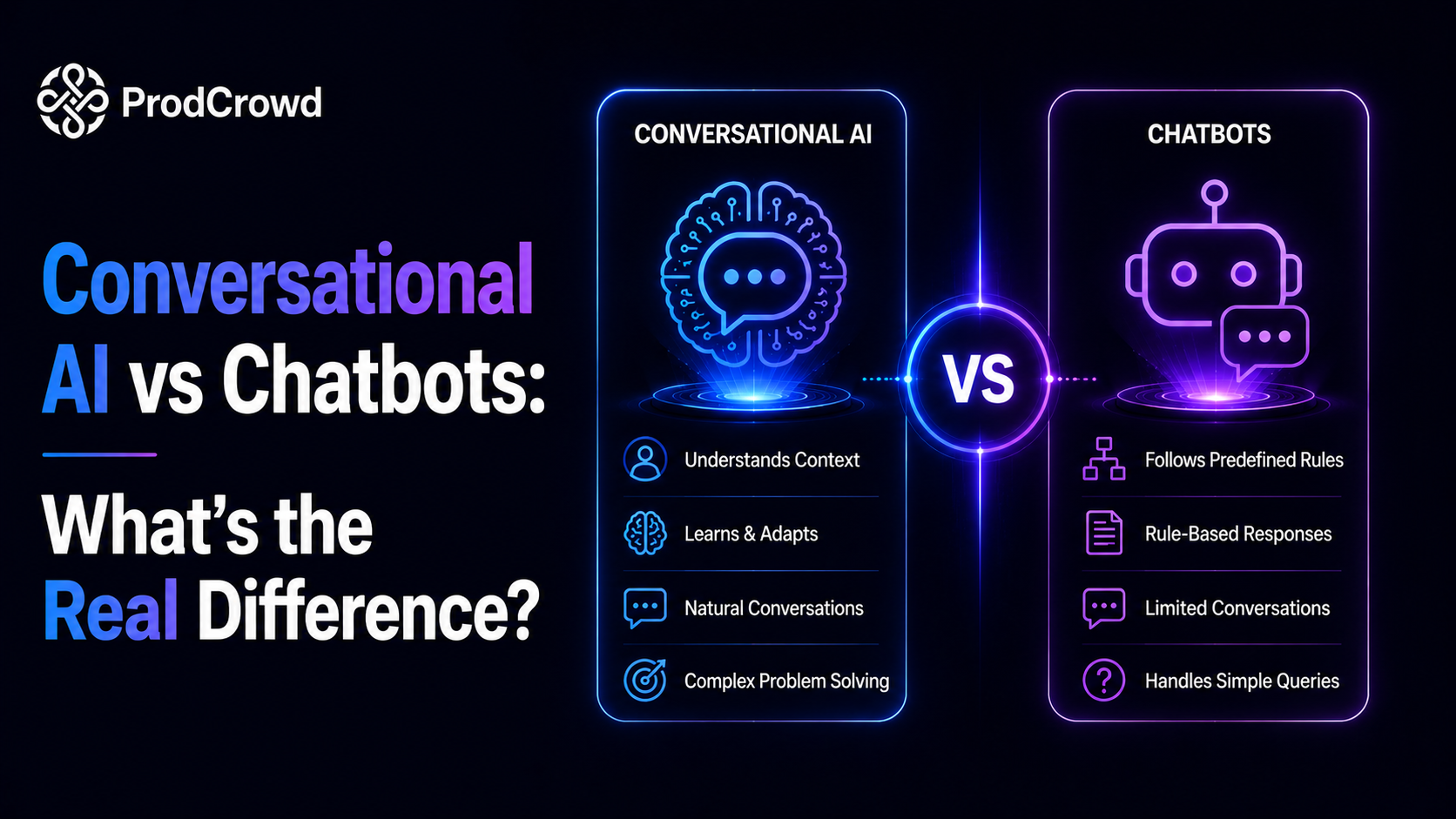
As businesses continue investing in AI-powered customer experiences, terms like chatbots, virtual assistants, and conversational AI are often used interchangeably. While they may appear similar, they represent different levels of intelligence and automation.
Many organizations deploy basic chatbots expecting them to deliver human-like conversations, only to find that rule-based systems struggle with complex customer interactions. On the other hand, conversational AI platforms can understand intent, maintain context, integrate with business systems, and automate end-to-end customer journeys.
Understanding the difference between conversational AI vs chatbots is essential for choosing the right technology for your customer support, sales, and business operations.
In this guide, we’ll explain how both technologies work, compare their capabilities, and help you determine which solution aligns with your business goals.
What Is a Chatbot?
A chatbot is a software application designed to simulate conversations with users through predefined rules or scripted responses.
Traditional chatbots typically:
- Answer frequently asked questions
- Provide basic product information
- Collect customer details
- Route conversations to human agents
- Follow predefined conversation flows
They work well for simple, repetitive interactions but struggle when users ask unexpected or complex questions.
What Is Conversational AI?
Conversational AI is a more advanced technology that uses Artificial Intelligence, Natural Language Processing (NLP), Machine Learning (ML), and Large Language Models (LLMs) to understand, interpret, and respond to human conversations naturally.
Unlike traditional chatbots, conversational AI can:
- Understand user intent
- Maintain conversation context
- Handle complex questions
- Learn from interactions
- Generate natural responses
- Integrate with enterprise systems
- Execute business workflows
Rather than following fixed scripts, conversational AI adapts dynamically to each conversation.
Conversational AI vs Chatbots: Key Comparison
| Feature | Traditional Chatbots | Conversational AI |
| Intelligence | Rule-based | AI-powered |
| Understanding | Keyword matching | Intent recognition |
| Context Awareness | Limited | Maintains context |
| Learning Ability | None | Continuously improves |
| Personalization | Minimal | Highly personalized |
| Workflow Automation | Limited | Advanced |
| Multi-Step Conversations | Basic | Excellent |
| CRM & ERP Integration | Basic | Deep enterprise integration |
| Scalability | Moderate | Enterprise-ready |
| Customer Experience | Functional | Human-like |
Key Differences Between Conversational AI and Chatbots
1. Rule-Based vs Intelligent Conversations
Traditional chatbots respond based on predefined decision trees.
For example:
Customer: “What are your business hours?”
The chatbot matches keywords and provides a scripted answer.
Conversational AI goes much further by understanding intent and context, allowing it to answer more nuanced questions and adapt responses naturally.
2. Context Awareness
Basic chatbots often forget previous messages during a conversation.
Conversational AI remembers context.
For example:
Customer:
“I ordered a laptop yesterday.”
Later:
“Can you change the delivery address?”
Conversational AI understands both messages are connected and continues the conversation without requiring the customer to repeat information.
3. Natural Language Understanding
Customers rarely use identical wording.
Traditional chatbots struggle with different phrasing.
Conversational AI understands variations such as:
- “Where is my order?”
- “Track my shipment.”
- “Has my package been dispatched?”
All three requests have the same intent.
4. Business System Integration
Modern businesses rely on multiple applications.
Conversational AI can integrate with:
- CRM platforms
- ERP systems
- Helpdesk software
- Knowledge bases
- Payment gateways
- Inventory systems
- HR platforms
This enables AI to perform real business tasks rather than simply answering questions.
5. Continuous Learning
Traditional chatbots require manual updates whenever new scenarios arise.
Conversational AI improves by learning from:
- Customer conversations
- Business knowledge
- User feedback
- Historical interactions
- Enterprise documentation
This makes responses more accurate over time.
When Is a Traditional Chatbot Enough?
A rule-based chatbot is suitable when your business needs to:
- Answer FAQs
- Capture leads
- Route inquiries
- Share business hours
- Provide contact information
- Collect feedback
For small businesses with simple customer interactions, chatbots can be an affordable starting point.
When Should You Choose Conversational AI?
Enterprise conversational AI is the better choice when your organization needs to:
- Automate customer support
- Qualify sales leads
- Personalize conversations
- Handle complex queries
- Access business knowledge
- Integrate with enterprise software
- Support multiple languages
- Scale customer engagement
It is particularly valuable for organizations handling high conversation volumes.
Business Benefits of Conversational AI
Companies implementing conversational AI often experience measurable improvements across customer service and operations.
Better Customer Experience
Customers receive faster, more relevant, and personalized responses.
Higher Employee Productivity
Support teams spend less time on repetitive questions and more time solving complex customer issues.
24/7 Availability
Conversational AI provides continuous support without requiring additional staffing.
Increased Sales Opportunities
AI can qualify leads, recommend products, schedule meetings, and guide customers through the buying journey.
Lower Operational Costs
Automation reduces support costs while improving service quality and response times.
Industry Use Cases
Conversational AI is transforming customer interactions across industries.
SaaS
- Customer onboarding
- Product guidance
- Technical support
- Subscription management
Healthcare
- Appointment scheduling
- Patient FAQs
- Prescription reminders
- Medical information assistance
Financial Services
- Account assistance
- Loan inquiries
- Fraud alerts
- Payment support
Retail & eCommerce
- Product recommendations
- Order tracking
- Returns processing
- Personalized shopping experiences
Manufacturing
- Distributor support
- Technical documentation
- Service requests
- Spare parts assistance
Common Myths About Conversational AI
Myth 1: Conversational AI Replaces Human Agents
Reality: AI handles repetitive tasks while human agents focus on complex conversations and relationship building.
Myth 2: AI Is Only for Large Enterprises
Today, businesses of all sizes can deploy conversational AI solutions based on their requirements and budget.
Myth 3: Chatbots and Conversational AI Are the Same
Traditional chatbots follow scripts, while conversational AI understands language, context, and intent to deliver more intelligent interactions.
How to Choose the Right Solution
Choose a chatbot if:
- You have limited automation needs.
- Most customer questions are repetitive.
- Your workflows are simple.
- Budget is the primary concern.
Choose conversational AI if:
- Customer interactions are complex.
- You want personalized experiences.
- Your business relies on CRM or ERP systems.
- You need workflow automation.
- You expect rapid business growth.
For many organizations, conversational AI delivers greater long-term value despite a higher initial investment.
The Future of Customer Conversations
The next generation of conversational AI will go beyond answering questions.
Future capabilities include:
- AI agents with autonomous decision-making
- Voice-enabled virtual assistants
- Multi-agent collaboration
- Emotion-aware interactions
- Real-time multilingual conversations
- Personalized customer journeys
- Predictive customer support
- AI-powered business automation
These innovations will redefine how businesses engage with customers across every channel.
Why Businesses Need Enterprise Conversational AI
Public chatbot platforms often lack the flexibility and security required by enterprises.
Enterprise conversational AI offers:
- Secure deployment
- Private knowledge bases
- CRM and ERP integration
- Role-based access controls
- Workflow automation
- Compliance management
- AI analytics
- Scalable architecture
These capabilities enable organizations to deliver exceptional customer experiences while protecting business data.
How ProdCrowd Builds Enterprise Conversational AI Solutions
At ProdCrowd, we help businesses move beyond basic chatbots by developing intelligent conversational AI solutions tailored to enterprise needs.
Our services include:
- Custom Conversational AI Development
- Enterprise AI Chatbots
- AI Agent Development
- Retrieval-Augmented Generation (RAG)
- Private GPT Solutions
- CRM & ERP Integration
- Customer Support Automation
- Sales Automation
- AI Consulting
- Workflow Automation
Our solutions are designed to improve customer engagement, automate business processes, and deliver measurable ROI while integrating seamlessly with your existing technology stack.
People Also Search For
- conversational AI vs chatbots
- enterprise conversational AI
- AI chatbot solutions for businesses
- conversational AI platform
- enterprise AI chatbot
- AI customer support software
- intelligent virtual assistants
- AI customer service automation
- conversational AI development
- custom AI chatbot development
People Also Ask
What is the difference between conversational AI and a chatbot?
A chatbot typically follows predefined rules and scripted responses, while conversational AI uses machine learning and natural language processing to understand context, intent, and complex user requests.
Is conversational AI better than traditional chatbots?
For businesses with complex customer interactions, conversational AI offers greater flexibility, personalization, and automation capabilities than rule-based chatbots.
Can conversational AI integrate with CRM systems?
Yes. Enterprise conversational AI platforms can integrate with CRM, ERP, helpdesk software, payment systems, and internal knowledge bases to automate workflows and access business data.
Which industries benefit most from conversational AI?
Industries such as SaaS, healthcare, finance, retail, manufacturing, education, and logistics use conversational AI to improve customer service, streamline operations, and enhance user experiences.
How does ProdCrowd help businesses implement conversational AI?
ProdCrowd designs and develops custom conversational AI solutions that integrate with enterprise systems, automate customer interactions, and support digital transformation initiatives.
Frequently Asked Questions
Can conversational AI support multiple languages?
Yes. Modern conversational AI platforms can communicate in multiple languages, making them ideal for businesses serving global customers.
Does conversational AI replace customer support teams?
No. Conversational AI automates repetitive conversations while allowing human agents to focus on complex issues, relationship management, and high-value interactions.
How secure is enterprise conversational AI?
Enterprise conversational AI can be deployed with private infrastructure, encryption, access controls, audit logs, and compliance features to protect sensitive business information.
How long does it take to implement conversational AI?
Implementation depends on the complexity of integrations, business workflows, and customization. Many organizations begin with a pilot deployment before expanding across departments.
Why choose ProdCrowd?
ProdCrowd specializes in building enterprise-grade conversational AI solutions that go beyond traditional chatbots. From AI-powered customer support and intelligent virtual assistants to custom AI agents and secure enterprise integrations, we help businesses deliver exceptional customer experiences while improving operational efficiency.
Conclusion
While traditional chatbots remain useful for handling simple, repetitive queries, they are limited by predefined rules and scripted workflows. Conversational AI takes customer engagement to the next level by understanding intent, maintaining context, integrating with enterprise systems, and automating complex business processes.
As customer expectations continue to rise, organizations that invest in conversational AI will be better equipped to deliver personalized experiences, improve operational efficiency, and scale support without increasing costs.
If you’re ready to move beyond basic chatbots, ProdCrowd can help you design and implement secure, scalable, and enterprise-ready conversational AI solutions tailored to your business goals.