
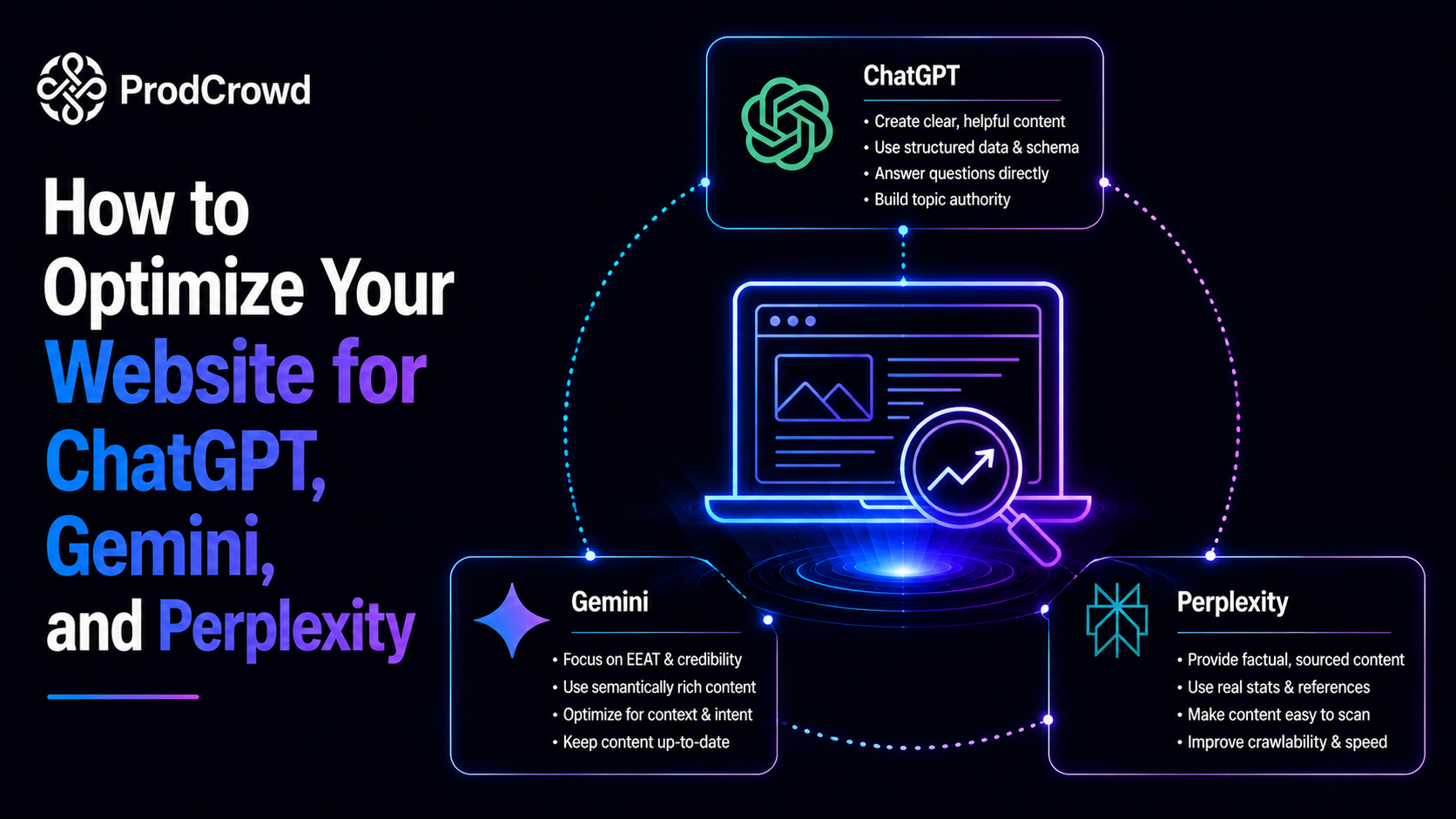
Search is changing faster than ever. While Google Search remains essential, millions of users are now asking questions directly to AI platforms like ChatGPT, Gemini, and Perplexity. Instead of scrolling through pages of search results, users expect AI to provide accurate, conversational answers in seconds.
This shift means businesses must rethink their content strategy. Traditional SEO is still important, but it’s no longer enough on its own. To appear in AI-generated answers, your website needs to be optimized for how large language models discover, understand, and reference information.
This emerging discipline is known as Generative Engine Optimization (GEO)—and it’s quickly becoming a key part of modern digital marketing.
In this guide, we’ll explain how to optimize your website for AI-powered search engines and increase your chances of being referenced in AI-generated responses.
What Is Generative Engine Optimization (GEO)?
Generative Engine Optimization (GEO) is the practice of creating and structuring website content so AI systems can easily understand, retrieve, and reference it when generating answers.
Unlike traditional SEO, which focuses on ranking web pages, GEO focuses on making your content:
- Easy for AI to understand
- Factually accurate
- Well-structured
- Rich in context
- Highly authoritative
The goal is to become a trusted source that AI models can confidently use when answering user questions.
Why AI Search Optimization Matters
AI search platforms are changing user behavior.
Instead of searching:
“Best CRM software”
Users now ask:
“What’s the best CRM for a 50-person SaaS company with HubSpot integration?”
AI provides a direct answer instead of a list of links.
Businesses that produce high-quality, trustworthy content are more likely to be cited or recommended within these AI-generated responses.
1. Create Topical Authority Instead of Isolated Articles
AI systems prefer websites that demonstrate deep expertise.
Instead of publishing unrelated blog posts, build comprehensive topic clusters.
Example:
If your company provides Generative AI solutions, create content covering:
- AI Agents
- RAG
- Private GPT
- Enterprise AI
- AI Security
- Prompt Engineering
- AI Automation
- AI Governance
- LLMs
- AI Integration
A connected library of content signals expertise and helps AI understand your domain authority.
2. Answer Questions Clearly
AI models are trained to answer questions.
Structure your content using clear headings such as:
What is RAG?
How do AI Agents work?
Why use Enterprise AI?
Provide concise, direct answers before expanding into detailed explanations.
This format increases the likelihood that AI systems will reference your content.
3. Use Semantic SEO
Modern AI understands topics—not just keywords.
Instead of repeating one keyword multiple times, naturally include related concepts, synonyms, and supporting terminology.
For example, an article about enterprise AI might also discuss:
- Large Language Models (LLMs)
- Retrieval-Augmented Generation (RAG)
- AI Agents
- Machine Learning
- Natural Language Processing (NLP)
- Knowledge Bases
- Workflow Automation
This creates richer context and improves AI comprehension.
4. Publish Original Expertise
AI platforms prioritize trustworthy and experience-based content.
Include:
- Case studies
- Original research
- Customer success stories
- Industry insights
- Expert opinions
- Real implementation examples
Unique content differentiates your website from generic AI-generated articles.
5. Structure Content for Easy Understanding
Well-organized content is easier for both users and AI systems.
Use:
- Clear headings (H2, H3)
- Short paragraphs
- Bullet points
- Numbered lists
- Comparison tables
- FAQs
- Summary sections
Logical structure improves readability and information retrieval.
6. Implement Structured Data
Structured data helps search engines and AI systems understand your content.
Useful schema types include:
- Organization
- Article
- FAQ
- Product
- Service
- Breadcrumb
- Review
- Person
Schema provides additional context that improves discoverability.
7. Improve E-E-A-T Signals
Google emphasizes:
- Experience
- Expertise
- Authoritativeness
- Trustworthiness
These signals also benefit AI search.
Strengthen your website by including:
- Detailed author bios
- Company information
- Customer testimonials
- Certifications
- Contact information
- Privacy policy
- References to credible sources where appropriate
Trustworthy websites are more likely to be surfaced by AI systems.
8. Build High-Quality Knowledge Content
AI models favor educational resources that answer real user questions.
Examples include:
- Ultimate guides
- Industry glossaries
- Technical documentation
- Buying guides
- Best practices
- Tutorials
- Comparison articles
Evergreen content continues to provide value long after publication.
9. Improve Technical SEO
Strong technical foundations help both search engines and AI crawlers.
Key areas include:
- Fast page speed
- Mobile responsiveness
- Secure HTTPS
- XML sitemaps
- Clean URL structure
- Internal linking
- Canonical tags
- Optimized Core Web Vitals
A technically sound website is easier to crawl and index.
10. Keep Content Fresh
AI systems prefer up-to-date information.
Regularly:
- Update statistics
- Refresh screenshots
- Revise product details
- Add new FAQs
- Expand guides
- Remove outdated information
Fresh content signals ongoing expertise and reliability.
11. Optimize for Conversational Search
Users interact with AI differently than traditional search engines.
Instead of targeting only short keywords, create content that answers natural-language queries such as:
- How do AI Agents improve customer support?
- What’s the difference between RAG and fine-tuning?
- Is Private GPT better than ChatGPT Enterprise?
This aligns with how users ask questions in AI tools.
12. Build Brand Authority Beyond Your Website
AI systems evaluate a brand’s overall digital presence.
Increase authority through:
- Industry publications
- Guest articles
- Podcasts
- Webinars
- LinkedIn thought leadership
- Case studies
- Customer reviews
A strong online reputation reinforces credibility.
Common Mistakes to Avoid
Many businesses still optimize only for traditional search engines.
Avoid:
- Keyword stuffing
- Thin content
- Duplicate articles
- Publishing AI-generated content without expert review
- Ignoring structured data
- Weak internal linking
- Outdated information
- Poor page experience
These issues reduce both search visibility and AI trust.
Measuring Success in the AI Search Era
Traditional SEO metrics remain valuable, but businesses should also monitor:
- Branded search growth
- Organic traffic quality
- AI referral traffic (where measurable)
- Content engagement
- Topic authority
- Lead generation
- Conversion rates
- Mentions across AI-assisted search experiences
Success is increasingly measured by visibility, trust, and business outcomes—not rankings alone.
Why Choose ProdCrowd for AI Search Optimization?
At ProdCrowd, we help organizations prepare for the future of search by combining advanced SEO expertise with Generative AI strategies.
Our AI search optimization services include:
- Generative Engine Optimization (GEO)
- AI-friendly content strategy
- Semantic SEO implementation
- Technical SEO improvements
- Structured data optimization
- Topic cluster development
- AI-ready knowledge base creation
- Enterprise content architecture
- AI visibility consulting
- Performance tracking and optimization
We don’t just optimize websites for search engines—we help businesses build authoritative digital assets that are discoverable by both traditional search and AI-powered platforms. By aligning SEO best practices with emerging AI search behaviors, we enable organizations to increase visibility, build trust, and attract qualified leads in the evolving search landscape.
People Also Search For
- optimize website for ChatGPT
- AI search optimization
- Generative Engine Optimization
- GEO SEO
- optimize website for AI search
- semantic SEO strategy
- AI-friendly content
- structured data SEO
- enterprise SEO strategy
- AI visibility optimization
People Also Ask
What is Generative Engine Optimization (GEO)?
GEO is the process of optimizing website content so AI platforms like ChatGPT, Gemini, and Perplexity can easily understand, retrieve, and reference it when generating answers.
Is traditional SEO still important?
Yes. Technical SEO, high-quality content, and authority remain essential. GEO builds on these foundations by making content more accessible and useful for AI-driven search experiences.
How can I improve my chances of appearing in AI-generated answers?
Create authoritative, well-structured, and factually accurate content, implement structured data, strengthen E-E-A-T signals, build topical authority, and answer user questions clearly.
Does structured data help AI search?
Structured data provides additional context about your content, making it easier for search engines and AI systems to interpret and organize information.
Why choose ProdCrowd?
ProdCrowd combines expertise in SEO, AI strategy, and Generative Engine Optimization to help businesses improve visibility across both traditional search engines and emerging AI-powered search platforms.
Frequently Asked Questions
Can AI search replace Google Search?
AI search is changing how users discover information, but traditional search engines remain an important traffic source. Businesses should optimize for both.
Should I rewrite all existing content for AI?
Not necessarily. Updating valuable content with clearer structure, semantic depth, current information, and strong internal linking is often more effective than starting from scratch.
How often should content be updated?
Review key pages regularly to ensure facts, examples, statistics, and recommendations remain accurate and relevant.
Does AI-generated content rank well?
Content quality matters more than how it was created. Articles should be accurate, original, helpful, and reviewed by subject matter experts before publication.
Can ProdCrowd help businesses become AI-search ready?
Yes. ProdCrowd provides end-to-end AI search optimization services, from content strategy and technical SEO to GEO implementation and performance optimization, helping businesses stay visible in the next generation of search.
Conclusion
The future of search is no longer limited to traditional search engines. As platforms like ChatGPT, Gemini, and Perplexity become trusted sources for information, businesses must evolve their digital strategies to remain visible. By combining strong technical SEO, authoritative content, semantic optimization, and Generative Engine Optimization (GEO), organizations can improve their chances of being referenced in AI-generated responses and build lasting online authority.
At ProdCrowd, we help businesses navigate this new era with AI-ready SEO strategies that align with how modern search works. Whether you’re building topical authority, optimizing your content for AI discovery, or developing a comprehensive GEO strategy, our team can help position your brand for long-term success in both traditional and AI-powered search.