
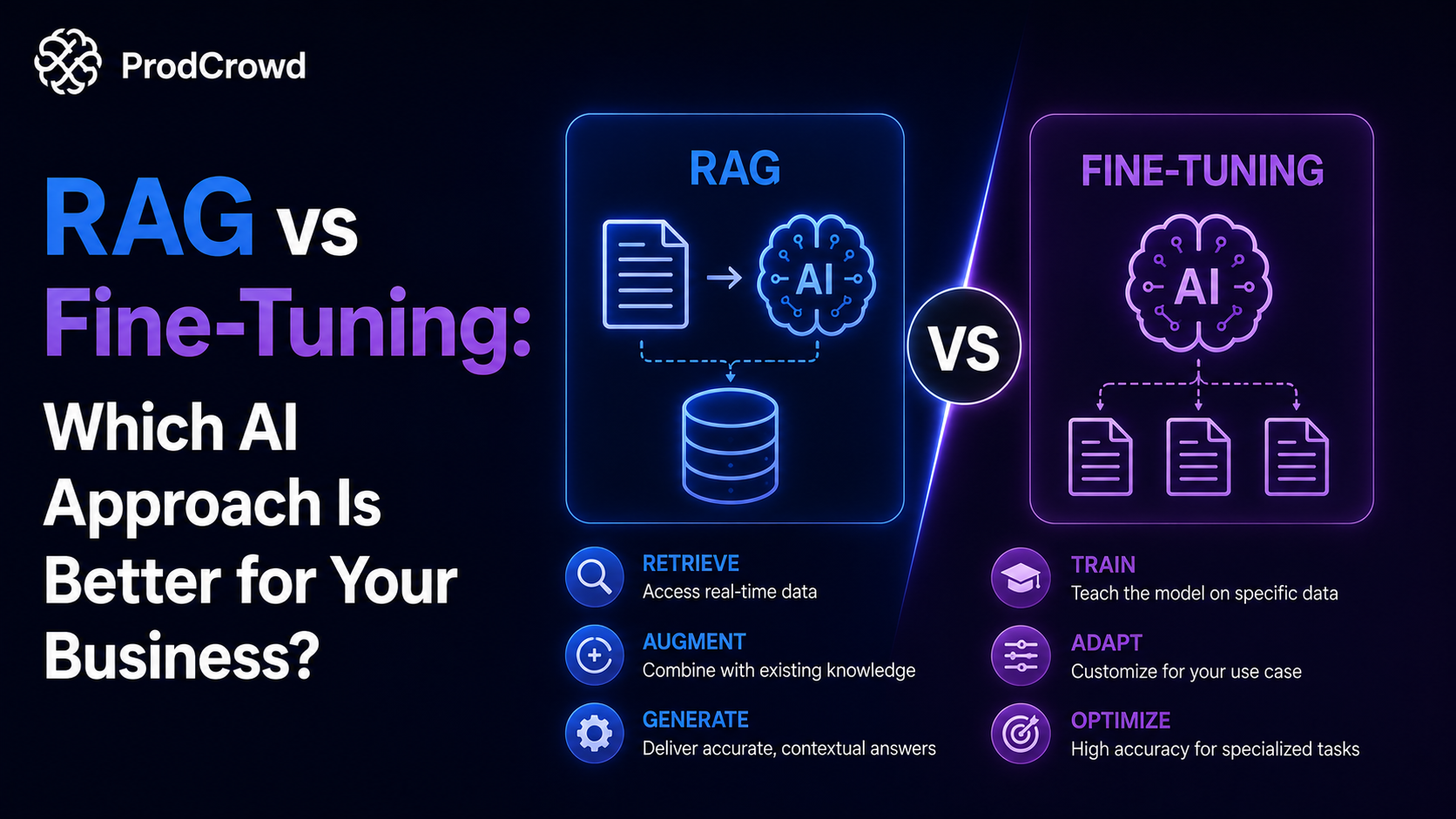
As businesses rapidly adopt Generative AI, one question consistently arises during implementation:
Should we use Retrieval-Augmented Generation (RAG) or Fine-Tuning?
Both approaches improve the performance of Large Language Models (LLMs), but they solve different problems. Choosing the wrong approach can lead to unnecessary costs, outdated responses, or poor business outcomes.
While many organizations assume fine-tuning is the answer for every AI project, that’s rarely the case. In fact, many successful enterprise AI solutions rely primarily on RAG, while others combine both techniques for maximum performance.
At ProdCrowd, we help businesses evaluate their AI requirements and build scalable solutions using RAG, Fine-Tuning, or hybrid architectures depending on their specific business objectives.
This guide explains the differences, advantages, limitations, and ideal use cases of each approach.
What Is Retrieval-Augmented Generation (RAG)?
Retrieval-Augmented Generation (RAG) is an AI architecture that enables language models to retrieve relevant information from external knowledge sources before generating a response.
Instead of relying only on what the model learned during training, RAG allows AI systems to access:
- Company Knowledge Bases
- Internal Documentation
- PDFs
- Policies
- Product Manuals
- CRM Data
- Databases
- Websites
- Enterprise Documents
This allows AI applications to generate responses using the latest available information.
What Is Fine-Tuning?
Fine-Tuning is the process of training a pre-trained language model on a specialized dataset so it learns new behaviors, writing styles, terminology, or domain-specific knowledge.
Instead of retrieving external information, the model itself is modified.
Fine-Tuning is commonly used for:
- Brand Voice
- Industry Terminology
- Legal Language
- Medical Documentation
- Specialized Customer Support
- Custom Classification
- Domain-Specific Tasks
The knowledge becomes part of the model’s behavior.
Key Differences Between RAG and Fine-Tuning
| Feature | RAG | Fine-Tuning |
| Knowledge Source | External Data | Model Training |
| Data Updates | Easy & Instant | Requires Retraining |
| Real-Time Information | Yes | No |
| Implementation Cost | Lower | Higher |
| Scalability | High | Moderate |
| Maintenance | Simple | Ongoing Retraining |
| Best For | Dynamic Knowledge | Specialized Behaviors |
| Enterprise Adoption | Very High | Targeted Use Cases |
For most enterprise AI assistants, RAG offers greater flexibility because information can be updated without retraining the model.
Benefits of Retrieval-Augmented Generation (RAG)
Businesses choose RAG because it offers several advantages.
Access to Real-Time Information
RAG retrieves the latest documents, ensuring responses remain current.
Lower Implementation Costs
No expensive retraining process is required whenever information changes.
Better Accuracy
Responses are grounded in trusted company knowledge rather than relying solely on the model’s memory.
Easier Maintenance
Updating documentation automatically improves AI responses.
Enterprise Scalability
RAG works well with growing knowledge bases and continuously expanding business information.
Benefits of Fine-Tuning
Fine-Tuning remains valuable for specific business requirements.
Advantages include:
- Improved domain expertise
- Consistent brand voice
- Better understanding of specialized terminology
- Enhanced task performance
- Custom response behavior
- Industry-specific language adaptation
It is particularly effective when consistent behavior matters more than accessing frequently updated information.
When Should Businesses Choose RAG?
RAG is the ideal solution when your AI system needs access to changing or frequently updated information.
Typical use cases include:
- Customer Support
- Internal Knowledge Assistants
- Employee Help Desks
- Product Documentation
- Policy Search
- Compliance Information
- Technical Documentation
- Enterprise Search
If your knowledge changes regularly, RAG is usually the better investment.
When Is Fine-Tuning the Better Choice?
Fine-Tuning is recommended when businesses need AI models that consistently behave in a specialized way.
Common scenarios include:
- Medical AI
- Legal Document Analysis
- Financial Classification
- Custom Language Generation
- Industry-Specific Terminology
- Brand Personality
- Specialized Prediction Models
The goal is to improve how the model behaves rather than expanding its knowledge.
Can Businesses Combine RAG and Fine-Tuning?
Yes—and many enterprise AI solutions do exactly that.
A hybrid architecture provides:
- Dynamic knowledge retrieval through RAG
- Customized model behavior through Fine-Tuning
- Higher response quality
- Improved user experience
- Greater business flexibility
This combination often delivers the best balance between accuracy, scalability, and personalization.
Common Mistakes Businesses Make
Organizations often struggle because they:
- Fine-tune models unnecessarily
- Ignore knowledge management
- Underestimate data quality
- Skip AI governance
- Choose technology before defining business goals
- Neglect system integration
- Fail to monitor AI performance
- Ignore user feedback
Successful AI implementation begins with solving business problems—not selecting technology first.
Industries Using RAG and Fine-Tuning
Both approaches are widely adopted across industries.
Healthcare
Patient support, clinical knowledge retrieval, medical documentation.
Financial Services
Compliance assistants, fraud detection, customer service automation.
Manufacturing
Technical documentation, maintenance guidance, operational knowledge.
Retail & eCommerce
Product recommendations, customer support, inventory assistance.
SaaS
Knowledge assistants, onboarding automation, technical support.
Professional Services
Proposal generation, legal documentation, research assistants.
How to Choose the Right AI Strategy
Ask the following questions before deciding:
- Does your information change frequently?
- Do you need real-time knowledge?
- Is brand voice important?
- Will the AI access internal documents?
- How often does your business update information?
- What is your implementation budget?
- Do you require enterprise scalability?
- What business problem are you solving?
The answers help determine whether RAG, Fine-Tuning, or a hybrid solution is most appropriate.
How ProdCrowd Helps Businesses Build AI Solutions
At ProdCrowd, we design enterprise AI systems that align with your operational goals rather than forcing a one-size-fits-all approach.
Our AI services include:
- Retrieval-Augmented Generation (RAG)
- Custom AI Agent Development
- Fine-Tuned AI Models
- Enterprise Knowledge Assistants
- AI Workflow Automation
- Conversational AI
- Multi-Agent Systems
- LLM Integration
- AI Consulting
- End-to-End AI Deployment
Every solution is designed to maximize accuracy, scalability, and business value.
Why Choose ProdCrowd?
Businesses trust ProdCrowd because we provide:
- Enterprise AI Expertise
- Custom AI Architectures
- RAG Implementation Specialists
- AI Agent Development
- Secure Enterprise Integrations
- Scalable AI Solutions
- Industry-Specific AI Consulting
- Continuous Optimization
- Dedicated Technical Support
- ROI-Driven AI Strategies
We help organizations move beyond AI experimentation and build production-ready intelligent systems.
People Also Search For
- RAG vs Fine-Tuning
- Retrieval-Augmented Generation vs fine tuning
- enterprise AI models
- AI implementation strategies
- custom AI agents
- enterprise generative AI
- RAG architecture
- fine tuning LLM
- AI knowledge retrieval
- enterprise AI consulting
People Also Ask
What is the difference between RAG and Fine-Tuning?
RAG retrieves information from external data sources before generating responses, while Fine-Tuning modifies the AI model itself to improve behavior or domain expertise.
Is RAG better than Fine-Tuning?
Neither is universally better. RAG is ideal for dynamic, frequently updated information, while Fine-Tuning is better for specialized behavior, terminology, or writing style.
Can RAG and Fine-Tuning be used together?
Yes. Many enterprise AI systems combine both approaches to achieve accurate knowledge retrieval alongside customized model behavior.
Which approach is more cost-effective?
For most businesses, RAG is more cost-effective because it allows knowledge updates without retraining the model, reducing maintenance costs.
Why choose ProdCrowd?
ProdCrowd helps businesses evaluate their AI needs and implement RAG, Fine-Tuned models, or hybrid AI architectures that deliver measurable operational and business outcomes.
Frequently Asked Questions
Does RAG require retraining the AI model?
No. RAG retrieves relevant information from external sources, allowing knowledge to be updated without retraining the language model.
Is Fine-Tuning suitable for every AI project?
No. Fine-Tuning is best when you need specialized behavior or domain expertise. Many business applications achieve better results using RAG alone.
Which solution scales better for enterprises?
RAG generally scales more easily because new knowledge can be added continuously without modifying the underlying AI model.
Can ProdCrowd integrate AI with existing business systems?
Yes. We integrate AI solutions with CRMs, ERPs, knowledge bases, cloud platforms, APIs, and enterprise applications to create seamless intelligent workflows.
Does ProdCrowd provide AI consulting before implementation?
Yes. Our team evaluates your business goals, data ecosystem, operational workflows, and technical requirements before recommending the most effective AI architecture.
Conclusion
The choice between RAG vs Fine-Tuning depends on your business objectives—not on which technology is more advanced. If your AI application needs access to constantly changing information, Retrieval-Augmented Generation offers flexibility, lower maintenance, and faster updates. If you require specialized behavior, industry expertise, or a consistent brand voice, Fine-Tuning can provide significant value.
In many enterprise environments, the strongest AI solutions combine both approaches to deliver intelligent, context-aware, and highly personalized experiences.
At ProdCrowd, we help organizations build scalable AI systems using the right architecture for their needs—whether that’s RAG, Fine-Tuning, or a hybrid strategy. Our goal is to ensure your AI investment drives measurable productivity, operational efficiency, and long-term business growth.