
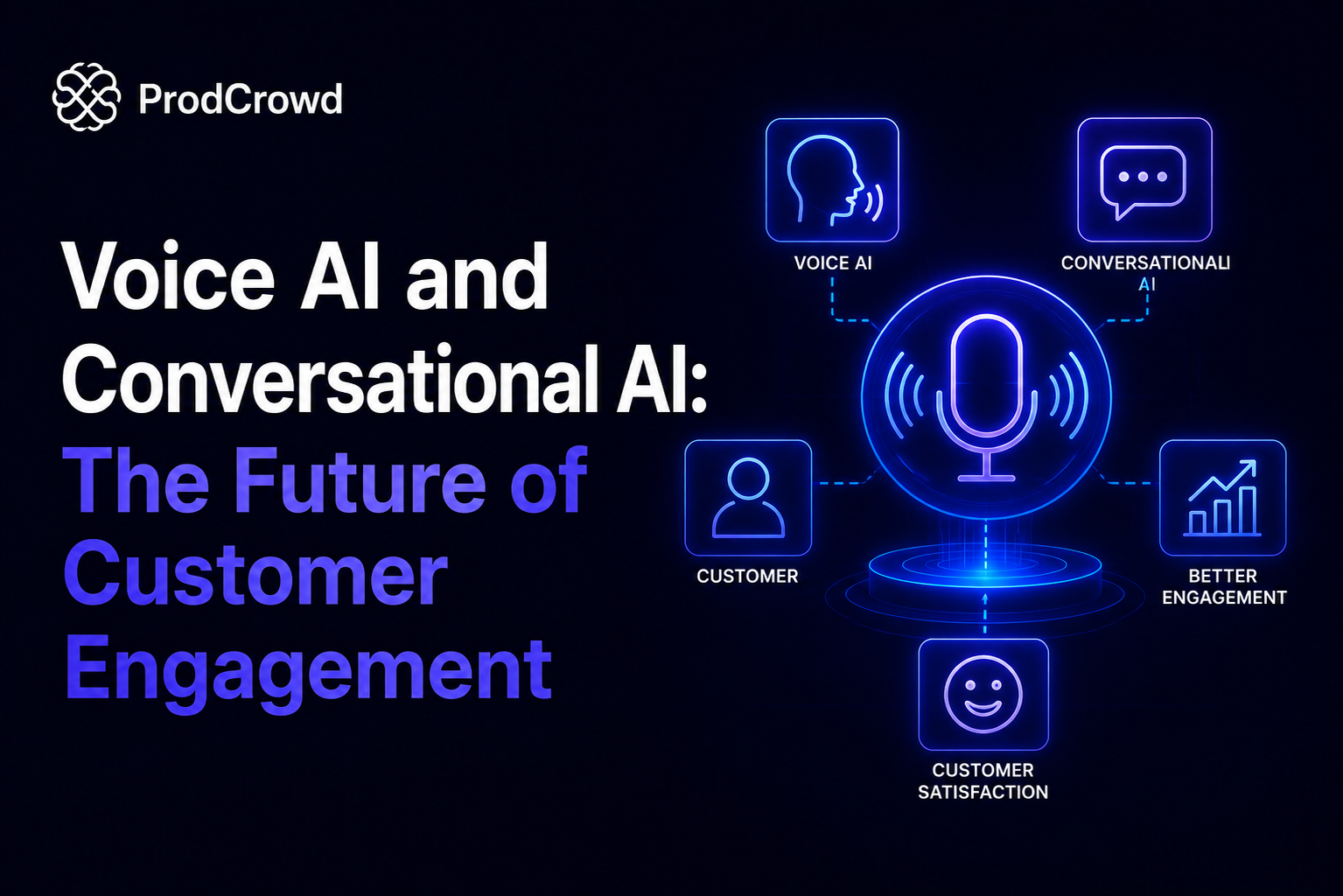
Customer expectations have changed dramatically over the past few years. Today’s customers expect businesses to provide instant responses, personalized interactions, and seamless support across multiple communication channels. Whether they contact a company through voice calls, websites, mobile apps, messaging platforms, or social media, they want fast, accurate, and human-like conversations available 24/7.
To meet these expectations, enterprises are increasingly adopting Voice AI and Conversational AI. While traditional chatbots and IVR systems rely on predefined rules and limited scripts, modern AI-powered systems understand natural language, maintain conversational context, learn from interactions, and automate complex customer journeys.
Voice AI enables customers to communicate naturally using speech, while Conversational AI powers intelligent interactions across text and voice channels. Together, these technologies are transforming customer support, sales, healthcare, banking, retail, hospitality, and enterprise operations by delivering personalized, scalable, and always-available customer engagement.
In this guide, we’ll explain how Voice AI and Conversational AI work, explore their differences, discuss why businesses are investing in them, and show how they are shaping the future of customer engagement in 2026.
Quick Answer
Voice AI allows users to interact with systems using natural speech, while Conversational AI enables intelligent conversations through both voice and text. Together, they help businesses automate customer interactions, improve response accuracy, reduce support costs, and deliver personalized experiences across multiple communication channels.
Key Takeaways
- Voice AI enables natural voice-based interactions.
- Conversational AI supports intelligent text and voice conversations.
- Businesses provide 24/7 customer engagement.
- AI reduces customer support costs.
- Customers receive faster and more personalized assistance.
- AI-powered engagement improves customer satisfaction and loyalty.
What Is Voice AI?
Quick Answer
Voice AI is an artificial intelligence technology that enables computers to understand spoken language, process voice commands, and respond naturally using synthesized speech. It combines speech recognition, natural language processing (NLP), machine learning, and text-to-speech technologies to create human-like voice interactions.
Instead of pressing buttons or navigating complex menus, users can simply speak naturally to an AI-powered assistant.
Core Components of Voice AI
- Automatic Speech Recognition (ASR)
- Natural Language Processing (NLP)
- Large Language Models (LLMs)
- Natural Language Understanding (NLU)
- Dialogue Management
- Text-to-Speech (TTS)
- Voice Biometrics (optional)
- AI Decision Engine
Voice AI enables businesses to automate voice conversations while delivering faster, more intuitive customer experiences.
What Is Conversational AI?
Quick Answer
Conversational AI is a technology that enables computers to understand, process, and respond to human conversations across multiple communication channels, including chat, voice, messaging apps, websites, email, and mobile applications. It creates natural, context-aware interactions that go far beyond rule-based chatbots.
Unlike traditional bots, Conversational AI remembers context, understands intent, and adapts responses based on user needs.
Key Capabilities
- Natural language understanding
- Human-like conversations
- Context awareness
- Multi-language support
- Personalized interactions
- Intelligent workflow automation
- Multi-channel communication
- Continuous learning
- CRM integration
- Enterprise knowledge access
Conversational AI creates seamless experiences that improve both customer satisfaction and operational efficiency.
How Do Voice AI and Conversational AI Work Together?
Quick Answer
Voice AI and Conversational AI complement each other to create intelligent customer interactions. Voice AI converts spoken language into text and generates natural speech responses, while Conversational AI understands user intent, retrieves relevant information, and manages the conversation flow across multiple systems.
Together, they provide end-to-end AI-powered customer engagement.
Typical Workflow
- Customer speaks or types a question.
- Voice AI converts speech into text (if voice input is used).
- Conversational AI analyzes intent and context.
- AI retrieves relevant information from connected systems.
- The AI generates an accurate response.
- Voice AI converts the response into natural speech (if needed).
- The conversation continues naturally until the request is resolved.
This combination enables businesses to deliver consistent, intelligent support across voice and digital channels.
Traditional Customer Support vs Voice AI & Conversational AI
Quick Answer
Traditional customer support often relies on manual processes, long wait times, and scripted interactions. Voice AI and Conversational AI automate customer conversations, provide instant responses, personalize interactions, and operate continuously, making them more efficient and scalable for modern enterprises.
| Traditional Customer Support | Voice AI & Conversational AI |
| Limited business hours | 24/7 availability |
| Human-only interactions | AI-assisted and human-assisted conversations |
| Long waiting times | Instant responses |
| Script-based communication | Context-aware conversations |
| Manual ticket routing | Intelligent request handling |
| Limited scalability | Easily scales to thousands of conversations |
| Higher operational costs | Lower support costs |
| Reactive customer service | Proactive customer engagement |
| Inconsistent responses | Consistent AI-powered assistance |
| Limited personalization | Personalized experiences using customer data |
Organizations adopting Voice AI and Conversational AI can improve service quality while reducing operational complexity and delivering exceptional customer experiences.
Business Benefits of Voice AI & Conversational AI
Quick Answer
Voice AI and Conversational AI help enterprises deliver faster, smarter, and more personalized customer interactions while reducing operational costs. By automating conversations across voice and digital channels, businesses can improve customer satisfaction, increase employee productivity, and scale customer engagement without significantly increasing support teams.
1. 24/7 Customer Availability
AI-powered virtual assistants provide uninterrupted support regardless of business hours or customer location.
Business Benefits
- Round-the-clock customer service
- Faster issue resolution
- Global customer support
- Improved customer satisfaction
2. Faster Response Times
Customers no longer need to wait in long queues. AI instantly understands requests and provides accurate responses.
Business Benefits
- Reduced waiting time
- Higher first-contact resolution
- Improved service quality
- Better customer experience
3. Personalized Customer Experiences
By integrating with CRM, ERP, and customer databases, AI can personalize every interaction using customer history, preferences, and previous conversations.
Business Benefits
- Personalized recommendations
- Better customer relationships
- Increased customer loyalty
- Higher conversion rates
4. Lower Customer Support Costs
AI automates repetitive inquiries, allowing human agents to focus on complex or high-value conversations.
Business Benefits
- Reduced operational expenses
- Improved agent productivity
- Efficient resource utilization
- Better ROI
5. Omnichannel Customer Engagement
Voice AI and Conversational AI provide a consistent experience across multiple communication channels.
Supported Channels
- Phone calls
- Website chat
- Mobile apps
- Facebook Messenger
- Microsoft Teams
- Slack
- SMS
Customers receive consistent support regardless of how they contact your business.
6. Data-Driven Business Insights
Every AI interaction generates valuable customer insights that help businesses improve products, services, and customer experiences.
Business Benefits
- Customer sentiment analysis
- Conversation analytics
- Performance reporting
- Better decision-making
- Trend identification
- Service optimization
7. Improved Employee Productivity
AI handles repetitive conversations, enabling employees to focus on strategic work that requires human expertise.
Business Benefits
- Reduced manual workload
- Better workforce efficiency
- Higher employee satisfaction
- Faster internal processes
Top Enterprise Use Cases
Quick Answer
Voice AI and Conversational AI are transforming customer engagement across industries by automating communication, improving service quality, and delivering personalized experiences. From customer support to healthcare and financial services, these technologies enable businesses to operate more efficiently while meeting growing customer expectations.
Customer Support Automation
AI assistants answer FAQs, troubleshoot issues, create support tickets, and escalate complex cases when needed.
Industries
- SaaS
- Telecom
- Retail
- Insurance
- Technology
AI Sales Assistants
Voice AI qualifies leads, schedules meetings, answers product questions, and guides customers throughout the buying journey.
Business Benefits
- Better lead qualification
- Increased conversions
- Faster follow-ups
- Improved sales efficiency
Healthcare Virtual Assistants
Healthcare organizations use Voice AI to schedule appointments, answer patient questions, provide medication reminders, and assist with follow-up care.
Business Benefits
- Reduced administrative workload
- Improved patient engagement
- Faster appointment management
Banking & Financial Services
Banks deploy Conversational AI for balance inquiries, payment assistance, fraud alerts, loan information, and secure customer authentication.
Business Benefits
- Enhanced customer convenience
- Faster financial services
- Improved security
- Reduced call center costs
Retail & E-Commerce
Retail businesses use AI assistants for product recommendations, order tracking, returns, inventory inquiries, and personalized shopping experiences.
Business Benefits
- Increased sales
- Better customer retention
- Higher average order value
- Improved shopping experience
Internal Enterprise Assistants
Employees can quickly access company knowledge, HR policies, IT support, training materials, and internal documentation using AI-powered assistants.
Business Benefits
- Faster knowledge retrieval
- Improved onboarding
- Reduced internal support requests
- Better collaboration
AI Receptionists & Virtual Call Centers
Voice AI can answer incoming calls, route customers to the correct department, collect caller information, and even complete routine service requests.
Business Benefits
- Professional first impression
- Reduced call abandonment
- Efficient call routing
- Scalable customer support
AI Agents with Voice Capabilities
Modern enterprises combine Voice AI, Conversational AI, and AI Agents to automate complete business workflows. For example, a customer can call to inquire about an order, the AI verifies identity, retrieves order details, updates the CRM, processes a return request, and schedules a pickup—all within a single conversation.
Why Choose ProdCrowd for Voice AI & Conversational AI Solutions?
Quick Answer
ProdCrowd develops enterprise-grade Voice AI and Conversational AI platforms that integrate seamlessly with your existing business systems. Our solutions combine advanced speech recognition, Large Language Models (LLMs), AI agents, and workflow automation to deliver secure, scalable, and highly personalized customer engagement experiences.
Why Businesses Choose ProdCrowd
- Custom Voice AI Development
- Conversational AI Platforms
- AI Agent Development
- Enterprise AI Consulting
- CRM & ERP Integration
- AI Workflow Automation
- Multi-Agent AI Systems
- Generative AI Solutions
- Cloud Deployment & Security
- Continuous Optimization & Support
Whether you’re building an AI-powered contact center, virtual assistant, voice-enabled AI agent, or omnichannel customer engagement platform, ProdCrowd delivers solutions designed for enterprise scale and measurable business outcomes.
Frequently Asked Questions
What is the difference between Voice AI and Conversational AI?
Voice AI enables spoken interactions using speech recognition and text-to-speech technologies, while Conversational AI manages intelligent conversations across both voice and text channels using natural language understanding and machine learning.
Which industries benefit most from Voice AI?
Healthcare, banking, insurance, retail, e-commerce, telecommunications, hospitality, logistics, education, and SaaS companies are among the industries seeing significant value from Voice AI.
Can Voice AI integrate with existing business software?
Yes. Voice AI platforms can integrate with CRM systems, ERP software, customer support platforms, knowledge bases, APIs, cloud applications, and communication tools.
Is Conversational AI suitable for small businesses?
Absolutely. Small businesses can use Conversational AI to automate customer support, qualify leads, schedule appointments, answer FAQs, and improve customer engagement without hiring large support teams.
Why choose ProdCrowd for Voice AI development?
ProdCrowd combines expertise in Voice AI, Conversational AI, AI Agents, enterprise integrations, and workflow automation to build secure, scalable, and business-focused AI solutions tailored to your organization’s needs.
Ready to Transform Customer Engagement with AI?
Voice AI and Conversational AI are redefining how businesses connect with customers. By automating conversations, personalizing interactions, and integrating seamlessly with enterprise systems, these technologies help organizations deliver exceptional customer experiences while improving operational efficiency.
Contact ProdCrowd today to build custom Voice AI and Conversational AI solutions that empower your business to engage customers smarter, faster, and at scale.
Conclusion
Voice AI and Conversational AI are shaping the future of customer engagement by enabling intelligent, personalized, and always-available interactions. Together, they help businesses automate support, improve customer satisfaction, reduce operational costs, and streamline workflows across industries. As enterprises continue investing in AI-driven digital transformation, organizations that adopt Voice AI and Conversational AI today will be better positioned to deliver superior customer experiences and achieve long-term competitive success. With ProdCrowd as your technology partner, you can implement enterprise-ready AI solutions that are secure, scalable, and built for measurable business growth.