

Top 5 Game-Changing Generative AI Use Cases in 2025
What is Generative AI?
Generative Artificial Intelligence (AI) has the ability to generate human-like content, automate tasks, and optimize workflows which creates a buzz in multiple industries. Unlike traditional AI that is confined to decision making, problem-solving, and pattern recognition, Generative AI creates one-of-a-kind pieces by going a step further. These designs can take the form of text, images, code, music videos and more.
By 2025, generative AI is projected to have a vast scope across different industry sectors, already increasing productivity, lowering expenses, and fostering innovation like never before. Businesses that adopt AI will have a remarkable advantage over others when it comes to automation, creativity, and advanced decision-making.
According to Statista, The global AI market is projected to reach $243.70 billion by 2025, with a 27.67% annual growth rate, reaching $826.70 billion by 2030.

Image source – statista.com
This blog explores how generative AI works and presents 05 powerful generative AI use cases shaping the future in 2025.
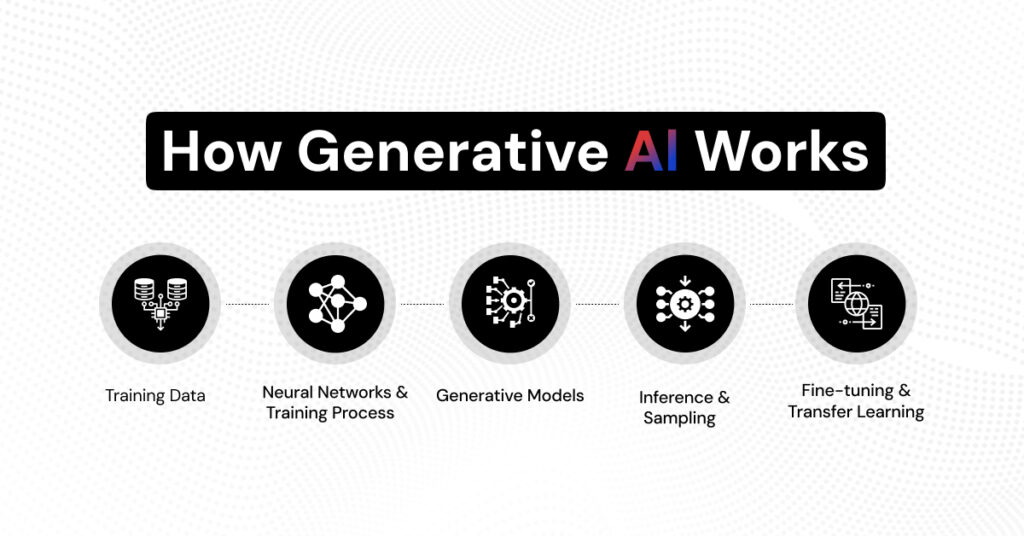
How Does Generative AI Work?
Generative AI is a form of deep learning that creates new content based on extensive contextually relevant datasets. These models analyze patterns and structures, and then produce new data that mimics human output.
1. Transformer-Based Models in Generative AI Use Cases
Some of the most utilized models within the AI sphere now include DALL E, GPT-4, BERT among many others. They utilize self-attention techniques for the generation of sequential data. These models can alter and process the sequentially generated information and produce audio, images, and text. These models are widely used with AI chatbots, content generation, and even AI research.
Example: AI-generated blog content, automated chatbot responses, and AI-powered translation services.
2. Generative Adversarial Networks (GANs) in AI-Driven Applications
GANs are composed of two important structures: a generator, or a GANs, that creates the data and a discriminator that measures the accuracy of the data produced. In this case, both neural networks work against one another. By utilizing this technique, AI can create terrifyingly realistic images, deepfake videos, or even fake human voices.
Example: AI-generated digital avatars, deepfake video editing, and hyper-realistic product advertisements.
3. Variational Auto-encoders (VAEs) for Synthetic Data Generation
VAEs encode and reconstruct information, allowing advanced systems to build and generate accurate synthetic replicas of real life datasets. This technology is renowned for data security, for training AI models, and even business processes for medical imaging are done utilizing these techniques.
Example: AI-generated training data for machine learning models, AI-powered image restoration, and synthetic voice cloning.
Here’s 5 Generative AI Use Cases
1. AI-Powered Content Creation

Content is being produced faster than ever before by using AI tools. Businesses are employing AI-based technologies such as ChatGPT, Jasper AI, and CopyAI, which allow automation of the content creation process without losing the element of creativity and engagement.
Using AI, marketers are now able to create custom content, SEO, and increase customer engagement without typing. AI is also useful in video scripts, ad copy, and even book writing.
2. Generative AI Use Cases in Software Development
Generative AI is automating software development in a major way by changing how coding, debugging, and even algorithm optimization is handled. With tools like GitHub Copilot and Open AI Codex, developers are aided by receiving pertinent code snippet suggestions, real-time error corrections, as well as overall code performance improvement suggestions.
AI guarantees the following: the faster it is to debug and develop software applications, the more secure the overall application is. AI also assists in automating document generation, software testing, and API development.
3. Healthcare & Drug Discovery – A Crucial Generative AI Use Case

AI plays a vital role in the healthcare industry, especially in drug development and medical studies. A Generative AI can analyze medical data, predict diseases, and aid in the design of new drug molecules. The best part is all this reduces costs associated with the development and also increases the pace of the approval process.
Pharmaceutical corporations are now embracing AI to model genetic compositions, drug interactions, and even improve patient diagnostics. This is a step towards personalized medicine and increases healthcare efficiency.
According to Forbes, AI-driven drug discovery is expected to reduce research costs by 40% and speed up production by 60%.
4. AI-Generated Visual & Video Content for Businesses
DALL.E 3 and MidJourney are two examples of AI design software that are revolutionizing graphic design and video production. Just like that, the AI can produce amazing graphics in seconds instead of minutes, eliminating the dependency on conventional graphic design freelance services and tools.
Marketers and content creators are now using AI tools for brand visuals, ad creatives, and social media graphics because it is highly effective. This guarantees fast content production without compromising on quality.
5. AI-Powered Customer Support – Enhancing Generative AI Use Cases

AI chatbots and Virtual assistants are handling customer conversations, not only providing replies instantly but also automating various customer service processes. Companies are now using AI chatbots to cut down their response times which ultimately helps in increasing productivity and giving better services to the customers.
AI chatbots can understand text, understand customer emotions, and provide accurate responses which means that human agents are not needed for most basic questions.
Final Thoughts on Generative AI Use Cases in 2025
By 2025, generative AI will be transforming content creation, software development, marketing, and healthcare. Automation that is supported by AI will enable companies to enjoy greater operational efficiency, enhanced decision-making, and accelerated innovation.
Companies need to consider new AI solutions these days if they want to remain competitive. Are you ready to use generative AI in your workflow?
Further Reading – Read more about The Future of AI Trends