
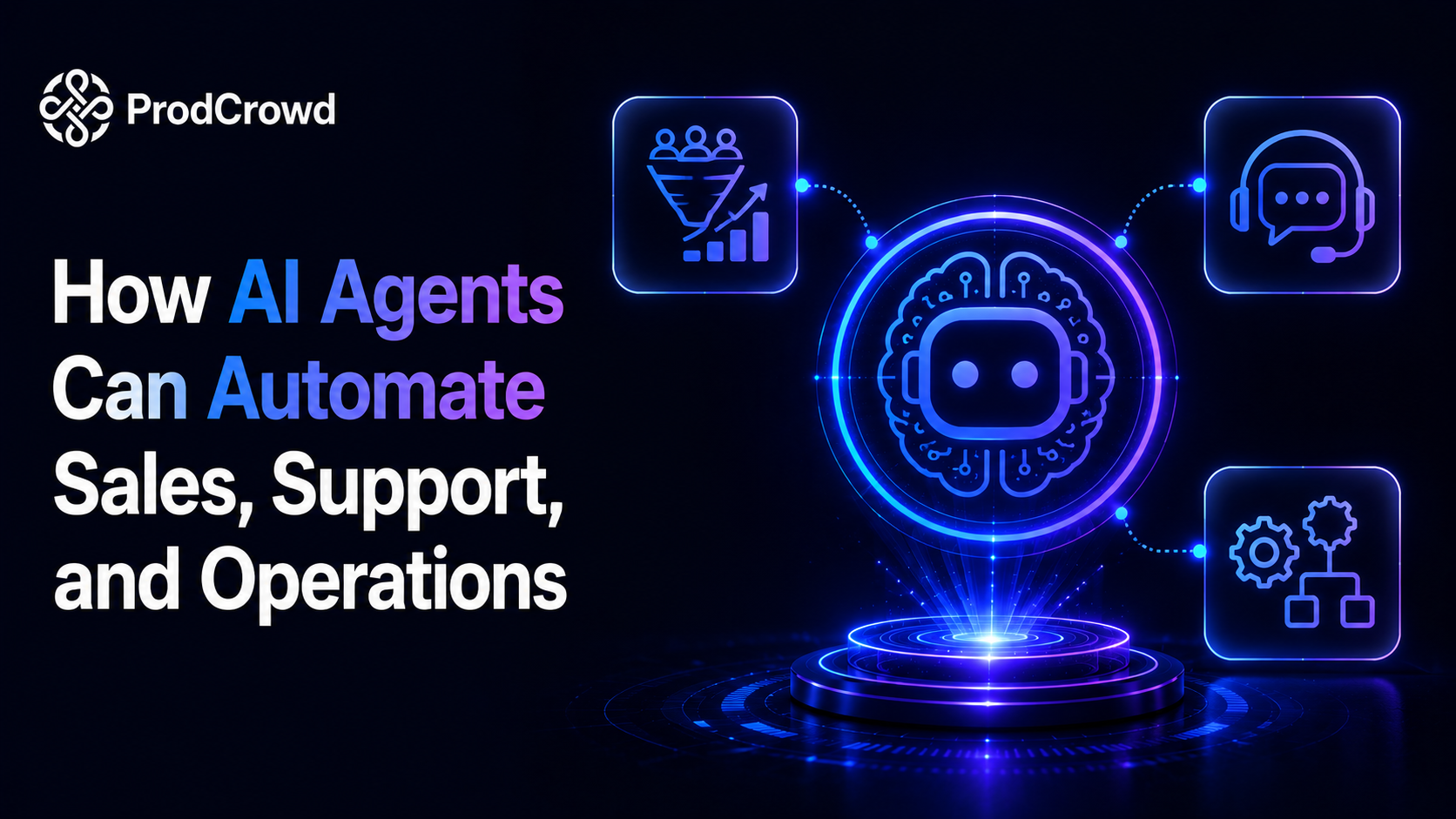
Artificial Intelligence is evolving beyond simple chatbots and content generators. Businesses are now adopting AI agents—intelligent systems capable of understanding context, making decisions, interacting with software, and completing complex workflows with minimal human intervention.
From qualifying leads and resolving customer inquiries to managing internal operations, AI agents are transforming how organizations work. Instead of automating isolated tasks, they automate complete business processes.
As companies seek greater efficiency and scalability, AI agents for business automation are becoming a strategic investment rather than an experimental technology.
In this guide, we’ll explore how AI agents work, where they create the most business value, and why they represent the next generation of enterprise automation.
What Are AI Agents?
An AI agent is an intelligent software system that can perceive information, reason about it, take actions, and continuously improve based on outcomes.
Unlike traditional automation tools that follow fixed rules, AI agents can:
- Understand natural language
- Analyze business data
- Make contextual decisions
- Execute multi-step workflows
- Learn from interactions
- Integrate with enterprise applications
They function as digital teammates capable of handling repetitive, data-driven tasks across departments.
How AI Agents Differ from Traditional Chatbots
While chatbots primarily answer predefined questions, AI agents are designed to complete actions.
A chatbot may:
- Answer FAQs
- Provide product information
- Direct users to resources
An AI agent can:
- Qualify leads
- Schedule meetings
- Update CRM records
- Generate proposals
- Process customer requests
- Trigger workflows
- Escalate complex issues automatically
This ability to perform tasks—not just conversations—makes AI agents significantly more valuable for businesses.
AI Agents for Sales Automation
Sales teams spend a large portion of their time on repetitive administrative work instead of building customer relationships.
AI sales automation helps eliminate these inefficiencies.
Lead Qualification
AI agents can:
- Analyze inbound inquiries
- Score leads based on predefined criteria
- Identify high-intent prospects
- Route qualified leads to the right sales representative
This ensures sales teams focus on opportunities most likely to convert.
Personalized Outreach
AI agents generate personalized:
- Cold emails
- Follow-up messages
- Meeting invitations
- Proposal summaries
Using CRM data and customer behavior, they tailor communication to improve engagement.
CRM Automation
Instead of manually updating records, AI agents automatically:
- Log customer interactions
- Update deal stages
- Record meeting notes
- Create follow-up tasks
- Generate pipeline reports
This improves data accuracy and saves valuable time.
Sales Forecasting
By analyzing historical sales data and pipeline activity, AI agents provide insights into:
- Revenue projections
- Deal health
- Sales performance
- Risk identification
These insights help leadership make informed decisions.
AI Agents for Customer Support
Customer expectations continue to rise, with users expecting instant, accurate, and personalized assistance.
AI agents enable support teams to meet these expectations while reducing operational costs.
24/7 Customer Assistance
AI agents provide around-the-clock support by:
- Answering customer questions
- Resolving common issues
- Guiding users through troubleshooting
- Escalating complex cases when needed
Intelligent Ticket Management
AI agents automatically:
- Categorize support tickets
- Prioritize urgent requests
- Assign tickets to the appropriate teams
- Track resolution progress
This streamlines support operations and reduces response times.
Knowledge Base Assistance
AI agents retrieve information from company documentation to deliver accurate, context-aware responses without requiring customers to search manually.
Multilingual Support
Businesses serving global markets can use AI agents to provide support in multiple languages, improving customer experience across regions.
AI Agents for Business Operations
Beyond customer-facing tasks, enterprise AI agents can automate a wide range of internal operations.
Human Resources
AI agents assist with:
- Employee onboarding
- Policy questions
- Leave requests
- Document management
- Training recommendations
Finance
Finance teams use AI agents for:
- Invoice processing
- Expense approvals
- Financial reporting
- Payment reminders
- Compliance documentation
IT Operations
AI agents help IT departments by:
- Resetting passwords
- Managing service requests
- Monitoring system performance
- Automating routine maintenance
- Providing technical support
Procurement
AI agents streamline procurement by:
- Tracking inventory
- Managing vendor communications
- Processing purchase requests
- Monitoring supply chain data
Benefits of AI Agents for Businesses
Organizations implementing AI agents experience several measurable advantages.
Increased Productivity
Employees spend less time on repetitive tasks and more time on strategic work.
Lower Operating Costs
Automation reduces manual effort, improves efficiency, and lowers administrative expenses.
Faster Response Times
AI agents respond instantly to customer and employee requests, improving service quality.
Improved Decision-Making
By analyzing large datasets, AI agents provide actionable insights that support business decisions.
Better Customer Experience
Personalized interactions and faster issue resolution lead to higher customer satisfaction and loyalty.
Industries Using AI Agents
AI agents are being adopted across industries, including:
- SaaS
- Healthcare
- Financial Services
- Manufacturing
- Retail & eCommerce
- Logistics
- Telecommunications
- Education
- Professional Services
- Insurance
Each industry leverages AI agents to automate workflows and enhance operational efficiency.
Best Practices for Implementing AI Agents
Successful AI adoption requires careful planning.
Recommended practices include:
- Identify repetitive, high-volume tasks.
- Define measurable business objectives.
- Integrate AI agents with existing systems.
- Ensure data security and compliance.
- Monitor performance continuously.
- Keep humans involved in decision-making where necessary.
- Train employees to collaborate with AI tools.
A phased implementation approach often delivers the best results.
The Future of AI Agents
AI agents are expected to become increasingly autonomous and capable of managing end-to-end business processes.
Emerging capabilities include:
- Multi-agent collaboration
- Autonomous workflow execution
- Real-time business intelligence
- Predictive decision-making
- Voice-enabled AI assistants
- Industry-specific AI agents
- Self-improving automation systems
As these technologies mature, AI agents will become essential components of enterprise digital transformation strategies.
Why Businesses Need Enterprise AI Agents
While public AI tools offer general capabilities, enterprise organizations require solutions that align with their specific workflows and security requirements.
Enterprise AI agents provide:
- Custom business logic
- Secure deployment
- Private knowledge bases
- CRM and ERP integration
- Role-based access control
- Compliance management
- Workflow orchestration
- Scalable automation
These features enable organizations to automate complex operations without compromising security or governance.
How ProdCrowd Builds Enterprise AI Agents
At ProdCrowd, we design and deploy custom AI agents that automate critical business functions across sales, customer support, and operations.
Our AI capabilities include:
- Custom AI Agent Development
- Sales Automation Solutions
- Customer Support AI
- Workflow Automation
- Retrieval-Augmented Generation (RAG)
- Private GPT Development
- Enterprise AI Integration
- AI Consulting
- CRM & ERP Integration
- Multi-Agent Systems
We work with businesses to create AI solutions that integrate seamlessly with existing technology stacks, improve productivity, and deliver measurable business outcomes.
People Also Search For
- AI agents for business automation
- AI sales automation
- Enterprise AI agents
- AI workflow automation
- Custom AI agents
- AI customer support
- AI automation for enterprises
- Business process automation AI
- Autonomous AI agents
- Enterprise AI solutions
People Also Ask
What are AI agents?
AI agents are intelligent software systems that can understand information, make decisions, execute tasks, and automate business workflows with minimal human intervention.
How do AI agents improve sales?
AI agents automate lead qualification, personalized outreach, CRM updates, follow-ups, and sales forecasting, allowing sales teams to focus on closing deals.
Can AI agents replace customer support teams?
AI agents handle routine inquiries and repetitive tasks, but human agents remain essential for complex issues, relationship management, and strategic decision-making.
What industries benefit from AI agents?
Industries such as healthcare, finance, manufacturing, SaaS, retail, logistics, and professional services use AI agents to improve efficiency and customer experience.
How does ProdCrowd help businesses implement AI agents?
ProdCrowd develops custom enterprise AI agents that integrate with existing business systems, automate workflows, and support digital transformation initiatives.
Frequently Asked Questions
Are AI agents secure for enterprise use?
Yes. Enterprise AI agents can be deployed in secure environments with encryption, access controls, compliance features, and private knowledge bases.
Can AI agents integrate with CRM and ERP systems?
Absolutely. AI agents can connect with platforms such as Salesforce, HubSpot, Microsoft Dynamics, SAP, and other enterprise applications to automate workflows and access business data.
How long does it take to implement AI agents?
Implementation timelines vary based on project complexity, integrations, and customization requirements. Many organizations begin with pilot projects before scaling across departments.
Will AI agents replace employees?
AI agents are designed to augment human teams by automating repetitive tasks, enabling employees to focus on strategic, creative, and customer-centric work.
Why choose ProdCrowd?
ProdCrowd specializes in building enterprise-grade AI agents tailored to your business processes. From sales automation and intelligent customer support to operational workflow optimization, our custom AI solutions help organizations increase efficiency, reduce costs, and accelerate digital transformation.
Conclusion
AI agents are redefining business automation by moving beyond simple conversations to executing real work. Whether it’s qualifying leads, resolving customer issues, managing workflows, or supporting internal operations, these intelligent systems enable organizations to operate faster, smarter, and more efficiently.
As AI technology continues to advance, businesses that invest in AI agents for business automation will be better positioned to improve productivity, enhance customer experiences, and maintain a competitive edge.
If you’re ready to automate sales, customer support, or operations, ProdCrowd can help you design, build, and deploy secure, enterprise-ready AI agents tailored to your unique business needs.