
Large Language Models (LLMs) have transformed how businesses search, generate, and interact with information. However, one of the biggest challenges with standalone AI models is that they don’t have access to your company’s latest internal knowledge. They may generate outdated, incomplete, or inaccurate responses—a phenomenon commonly known as hallucination.
This is why organizations are increasingly adopting Retrieval-Augmented Generation (RAG). By combining LLMs with enterprise knowledge bases, RAG delivers responses grounded in real business data, improving accuracy and reliability.
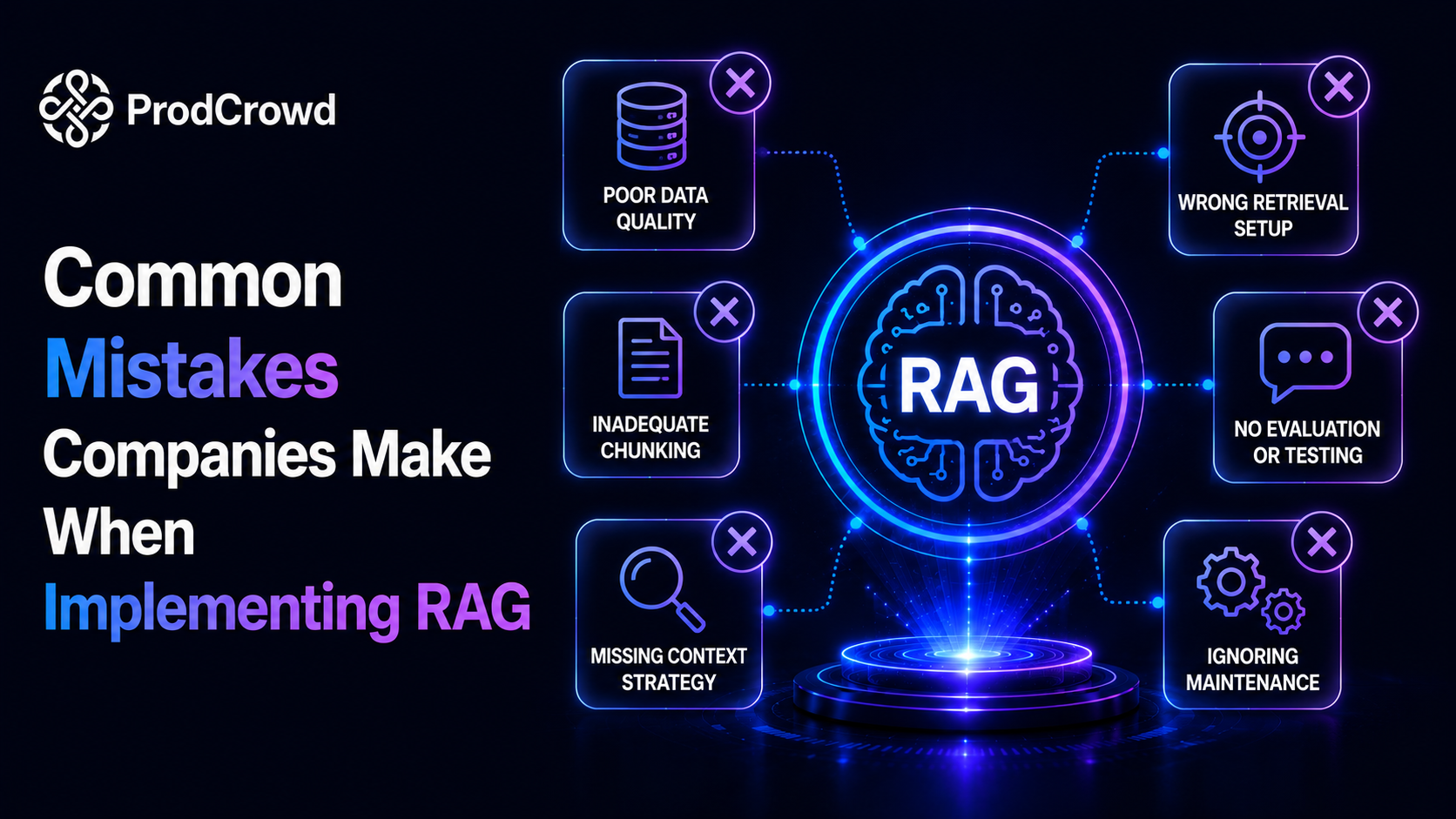
Despite its advantages, many companies struggle to realize the full value of RAG because of avoidable implementation errors. Understanding these RAG implementation mistakes can save significant time, reduce costs, and improve AI performance.
In this guide, we’ll explore the most common mistakes businesses make when deploying RAG systems and the best practices for building scalable enterprise AI solutions.
What Is Retrieval-Augmented Generation (RAG)?
Retrieval-Augmented Generation is an AI architecture that combines:
- Large Language Models (LLMs)
- Enterprise knowledge bases
- Vector databases
- Semantic search
- Document retrieval
Instead of relying only on a model’s training data, RAG retrieves relevant information from trusted business sources before generating a response.
This approach improves:
- Response accuracy
- Data freshness
- Source transparency
- Enterprise security
- Domain-specific knowledge
Why Businesses Are Adopting RAG
Organizations use RAG to build AI systems that can securely answer questions using internal business knowledge.
Common applications include:
- Enterprise search
- AI customer support
- Internal knowledge assistants
- Sales enablement
- Technical documentation
- Compliance assistance
- Employee self-service
- Contract analysis
When implemented correctly, RAG becomes the foundation of enterprise AI.
Mistake 1: Using Poor-Quality Data
A RAG system is only as good as the information it retrieves.
Many companies index:
- Outdated documents
- Duplicate files
- Incomplete documentation
- Unverified content
- Obsolete policies
Poor-quality knowledge leads to poor AI responses.
Best Practice
Create a governed knowledge base by:
- Removing duplicates
- Updating outdated documents
- Organizing content
- Defining ownership
- Performing regular audits
Clean data dramatically improves AI accuracy.
Mistake 2: Ignoring Document Chunking
One of the most overlooked aspects of RAG is document chunking.
Large documents should not simply be divided into random sections.
Poor chunking causes:
- Missing context
- Irrelevant retrieval
- Fragmented answers
- Reduced accuracy
Best Practice
Use semantic chunking strategies that preserve logical sections, headings, and relationships between concepts.
Well-structured chunks improve retrieval quality significantly.
Mistake 3: Choosing the Wrong Embedding Model
Embeddings determine how documents are represented inside vector databases.
Using generic embedding models for specialized industries often results in weak retrieval performance.
Best Practice
Select embedding models appropriate for:
- Technical documentation
- Healthcare
- Finance
- Manufacturing
- Legal
- Enterprise knowledge
Test multiple models before deployment.
Mistake 4: Focusing Only on the LLM
Many businesses spend most of their budget selecting the “best” language model while ignoring the retrieval layer.
In reality, retrieval quality often has a greater impact on response accuracy than the LLM itself.
Best Practice
Optimize:
- Knowledge organization
- Search quality
- Embedding models
- Retrieval pipelines
- Prompt engineering
A balanced architecture produces better results.
Mistake 5: Poor Prompt Engineering
Even with excellent retrieval, poorly designed prompts can produce incomplete or misleading responses.
Best Practice
Create prompts that instruct the model to:
- Use retrieved information first
- Avoid unsupported assumptions
- Cite available sources when possible
- Respond only with relevant information
- Handle uncertainty appropriately
Prompt engineering remains an essential component of RAG performance.
Mistake 6: Ignoring Security and Access Controls
Many enterprise knowledge bases contain confidential information.
Without proper security, AI systems may expose sensitive business data.
Best Practice
Implement:
- Role-based permissions
- Identity management
- Encryption
- Secure APIs
- Audit logs
- Compliance policies
Enterprise-grade security should be built into every RAG deployment.
Mistake 7: Not Measuring Retrieval Performance
Some organizations evaluate only the final AI response.
However, poor answers often result from poor retrieval rather than the language model itself.
Best Practice
Monitor metrics such as:
- Retrieval accuracy
- Precision
- Recall
- Response relevance
- Latency
- User satisfaction
Continuous evaluation leads to continuous improvement.
Mistake 8: Expecting RAG to Solve Every AI Problem
RAG is powerful, but it isn’t a universal solution.
Tasks involving:
- Complex reasoning
- Workflow automation
- Decision orchestration
- Autonomous actions
may require AI agents or additional enterprise AI architectures.
Best Practice
Use RAG where retrieval from trusted knowledge is essential, and combine it with AI agents for end-to-end business automation.
Mistake 9: Skipping Continuous Knowledge Updates
Business knowledge changes constantly.
Policies, pricing, documentation, and product information evolve over time.
Best Practice
Build automated pipelines that:
- Sync documents regularly
- Re-index new content
- Remove obsolete information
- Monitor data quality
Keeping the knowledge base current ensures accurate AI responses.
Mistake 10: Building Without a Clear Business Objective
Many organizations implement RAG simply because it’s trending.
Without defined goals, projects often fail to deliver measurable value.
Best Practice
Start with specific business outcomes such as:
- Faster customer support
- Reduced employee search time
- Improved sales productivity
- Better knowledge management
- Lower operational costs
Business value—not technology—should drive implementation.
Retrieval-Augmented Generation Best Practices
Successful Retrieval-Augmented Generation best practices include:
- Build a clean knowledge base
- Use semantic document chunking
- Select high-quality embedding models
- Optimize retrieval before generation
- Apply strong prompt engineering
- Secure enterprise data
- Continuously monitor performance
- Keep documents updated
- Measure business KPIs
- Scale gradually through pilot projects
These practices improve both AI accuracy and long-term maintainability.
Benefits of Enterprise RAG Solutions
Organizations implementing enterprise RAG solutions gain:
- More accurate AI responses
- Reduced hallucinations
- Better knowledge management
- Faster employee productivity
- Improved customer support
- Stronger compliance
- Secure access to enterprise data
- Lower operational costs
RAG transforms static company documentation into an intelligent knowledge assistant.
When Should Your Business Use RAG?
RAG is ideal if your organization has:
- Large document repositories
- Internal knowledge bases
- Product documentation
- Compliance manuals
- Technical documentation
- Customer support resources
- Frequently changing information
It is especially valuable for enterprises where accuracy and security are critical.
How ProdCrowd Builds Enterprise RAG Solutions
At ProdCrowd, we design enterprise-grade Retrieval-Augmented Generation systems that integrate seamlessly with your business knowledge and workflows.
Our expertise includes:
- Custom RAG Development
- Enterprise Knowledge Assistants
- Vector Database Implementation
- Private GPT Solutions
- AI Agent Integration
- Semantic Search
- LLM Integration
- AI Consulting
- Enterprise AI Architecture
- Secure AI Deployments
We help organizations build scalable, secure, and highly accurate AI systems tailored to their unique business needs.
People Also Search For
- RAG implementation mistakes
- Retrieval-Augmented Generation best practices
- Enterprise RAG solutions
- RAG architecture
- Vector database implementation
- Enterprise AI search
- Private GPT with RAG
- AI knowledge management
- Semantic search solutions
- RAG development services
People Also Ask
What is the biggest mistake in RAG implementation?
The most common mistake is using poor-quality or outdated enterprise data. Even the best language model cannot provide accurate responses if the underlying knowledge base is unreliable.
Why is document chunking important in RAG?
Proper chunking preserves context and improves retrieval accuracy, helping the AI generate more relevant and complete responses.
Does RAG eliminate AI hallucinations?
RAG significantly reduces hallucinations by grounding responses in retrieved enterprise data, but it does not eliminate them entirely. Human oversight and continuous optimization remain important.
How do enterprise RAG solutions improve business performance?
They enable employees and customers to access accurate information quickly, improving productivity, reducing support costs, and enhancing decision-making.
How does ProdCrowd help businesses implement RAG?
ProdCrowd develops secure, enterprise-ready RAG solutions that integrate with internal knowledge bases, vector databases, and business applications to deliver accurate, scalable AI experiences.
Frequently Asked Questions
Can RAG work with private company data?
Yes. Enterprise RAG systems are specifically designed to securely retrieve information from private knowledge bases while enforcing access controls and compliance policies.
Which industries benefit most from RAG?
Healthcare, finance, legal, manufacturing, SaaS, education, insurance, and customer support organizations commonly use RAG to improve knowledge retrieval and AI accuracy.
Do I need a vector database for RAG?
Most enterprise RAG implementations use vector databases because they enable efficient semantic search and fast retrieval of relevant information.
How long does a RAG implementation take?
The timeline depends on factors such as data quality, system integrations, document volume, and customization requirements. Many organizations begin with a pilot project before expanding across departments.
Why choose ProdCrowd?
ProdCrowd specializes in designing secure, enterprise-grade RAG solutions tailored to your business. From knowledge base architecture and vector search to custom AI agents and private GPT deployments, we help organizations build AI systems that deliver accurate, reliable, and measurable business outcomes.
Conclusion
Retrieval-Augmented Generation has become one of the most effective ways for businesses to build accurate, trustworthy AI applications. However, success depends on more than simply connecting a language model to a document repository. Clean data, thoughtful document chunking, robust security, optimized retrieval, and continuous monitoring are all critical to delivering reliable results.
By avoiding these common RAG implementation mistakes and following proven best practices, organizations can create AI systems that enhance productivity, improve customer experiences, and unlock the full value of their enterprise knowledge.
If you’re planning to build or scale a RAG-powered solution, ProdCrowd provides the expertise, architecture, and implementation support needed to develop secure, scalable, and enterprise-ready AI applications.