
Generative AI has become a major competitive advantage for businesses looking to improve productivity, automate workflows, and deliver better customer experiences.
However, organizations often face a critical decision early in their AI journey:
Should we use an off-the-shelf AI model like ChatGPT, Claude, or Gemini, or invest in a custom generative AI solution?
The answer depends on business goals, data requirements, scalability needs, compliance considerations, and expected ROI.
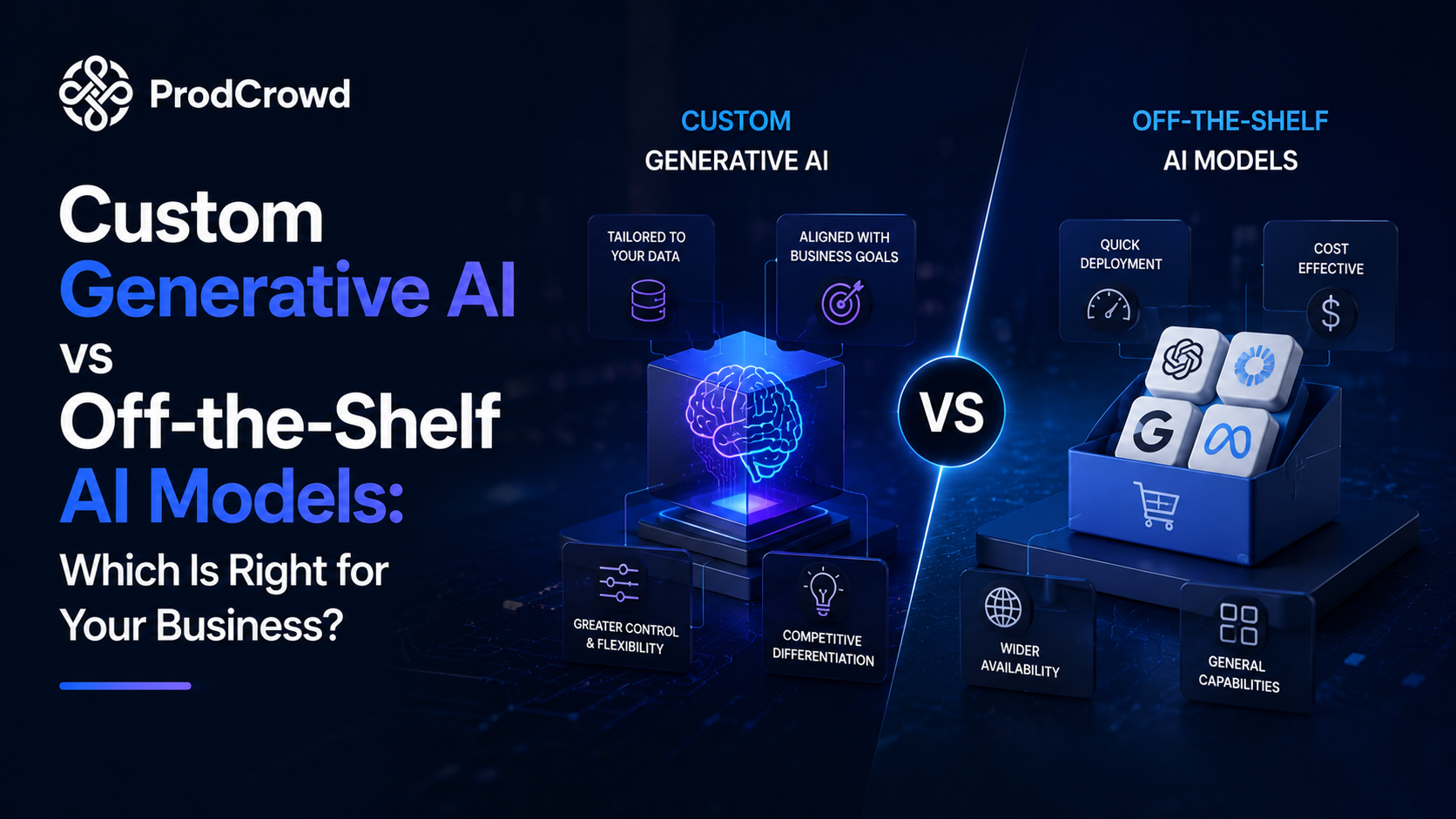
While off-the-shelf AI models provide quick access to powerful capabilities, custom AI solutions offer greater control, personalization, and competitive differentiation.
This guide compares both approaches to help business leaders make informed AI investment decisions.
Understanding Off-the-Shelf AI Models
Off-the-shelf AI models are pre-built AI platforms developed by major AI providers.
Examples include:
- ChatGPT
- Gemini
- Claude
- Microsoft Copilot
- Enterprise AI Assistants
These platforms are designed for immediate use without requiring organizations to build or train models from scratch.
Benefits of Off-the-Shelf AI
Fast Deployment
Businesses can start using AI within days rather than months.
Lower Initial Costs
No model training or infrastructure investment is required.
Proven Performance
Models have already been tested at scale.
Continuous Updates
Providers regularly improve performance and capabilities.
Easy Accessibility
Employees can adopt tools quickly with minimal technical expertise.
For many businesses, off-the-shelf AI represents the fastest path to AI adoption.
Understanding Custom Generative AI
Custom generative AI solutions are tailored specifically to an organization's data, workflows, industry requirements, and business objectives.
These solutions often leverage foundation models while incorporating:
- Proprietary business data
- Internal knowledge bases
- Industry-specific information
- Custom workflows
- Enterprise integrations
Rather than relying solely on public AI platforms, organizations create AI systems designed specifically for their operations.
Benefits of Custom Generative AI
Business-Specific Intelligence
Models understand company terminology, processes, and data.
Enhanced Accuracy
Responses are based on enterprise knowledge rather than generic internet information.
Greater Security
Organizations maintain stronger control over sensitive information.
Competitive Advantage
Custom AI becomes a unique business asset.
Workflow Integration
AI can connect directly to internal systems and processes.
Custom solutions often create greater long-term strategic value.
Custom Generative AI vs Off-the-Shelf AI: Key Differences
Deployment Speed
Off-the-Shelf AI
Deployment can occur almost immediately.
Businesses can begin experimenting within hours or days.
Custom Generative AI
Implementation typically requires:
- Planning
- Data preparation
- Integration
- Testing
- Training
Deployment often takes several weeks or months.
Winner
Off-the-Shelf AI
Initial Investment
Off-the-Shelf AI
Typically requires subscription fees.
Costs are predictable and relatively low.
Custom Generative AI
May require investment in:
- Development
- Infrastructure
- AI consulting
- Data preparation
- Integration
Winner
Off-the-Shelf AI
Personalization
Off-the-Shelf AI
Provides generalized responses suitable for broad audiences.
Custom Generative AI
Tailored specifically to:
- Internal processes
- Industry knowledge
- Customer requirements
- Business workflows
Winner
Custom Generative AI
Data Security and Compliance
Off-the-Shelf AI
Enterprise versions often include security controls, but organizations may have limited control over model behavior.
Custom Generative AI
Provides greater control over:
- Data storage
- Access permissions
- Compliance frameworks
- Security policies
Winner
Custom Generative AI
Integration Capabilities
Off-the-Shelf AI
Integrations are often available but may be limited.
Custom Generative AI
Can integrate directly with:
- CRM platforms
- ERP systems
- Knowledge bases
- Customer portals
- Internal applications
Winner
Custom Generative AI
Scalability
Off-the-Shelf AI
Scales effectively for individual productivity use cases.
Custom Generative AI
Scales across enterprise workflows and business functions.
Winner
Custom Generative AI
Competitive Differentiation
Off-the-Shelf AI
Available to competitors using the same tools.
Custom Generative AI
Creates unique business capabilities competitors cannot easily replicate.
Winner
Custom Generative AI
When Off-the-Shelf AI Is the Right Choice
Many organizations can achieve significant value without building custom models.
Off-the-shelf AI is often ideal when:
You Need Quick Results
Immediate productivity improvements are a priority.
Budget Is Limited
Organizations want to minimize upfront investment.
AI Adoption Is New
Businesses are still exploring AI opportunities.
General-Purpose Tasks Dominate
Examples include:
- Content creation
- Research assistance
- Meeting summaries
- Internal productivity
Limited Internal Data Exists
Custom models require quality data to create value.
For startups and smaller organizations, off-the-shelf solutions often provide an excellent starting point.
When Custom Generative AI Makes More Sense
Custom AI becomes increasingly valuable as organizational complexity grows.
You Have Unique Business Processes
Standard AI tools may not understand specialized workflows.
You Handle Sensitive Data
Industries with strict compliance requirements often require greater control.
Examples include:
- Healthcare
- Financial Services
- Legal Services
- Government
You Need Deep System Integration
Custom solutions can connect directly to enterprise applications.
AI Is a Strategic Priority
Organizations seeking long-term competitive advantages often benefit from custom AI investments.
You Want Proprietary Intelligence
Custom AI can leverage internal knowledge unavailable to public models.
Real-World Examples
Example 1: SaaS Company
Off-the-Shelf AI Use Case
Using ChatGPT for:
- Marketing content
- Meeting summaries
- Internal documentation
Result
Improved employee productivity with minimal investment.
Example 2: Healthcare Organization
Custom AI Use Case
Developing a patient-support assistant trained on internal clinical resources.
Result
Improved patient engagement while maintaining compliance requirements.
Example 3: Enterprise Manufacturing Company
Custom AI Use Case
Building an AI-powered maintenance assistant connected to equipment data.
Result
Faster troubleshooting and reduced downtime.
Example 4: Financial Institution
Custom AI Use Case
Deploying AI for internal risk analysis and regulatory compliance support.
Result
Enhanced efficiency while maintaining security controls.
The Hybrid Approach: The Best of Both Worlds
Many organizations are choosing a hybrid AI strategy.
Instead of selecting one option exclusively, they combine:
Off-the-Shelf AI
For:
- Employee productivity
- Content generation
- Research assistance
Custom AI Solutions
For:
- Customer-facing applications
- Proprietary workflows
- Industry-specific requirements
- Enterprise knowledge systems
This approach often provides the best balance between speed and long-term value.
Common Mistakes Businesses Make
Building Custom AI Too Early
Organizations should validate business value before making large investments.
Relying Solely on Generic AI
Enterprise workflows often require deeper customization.
Ignoring Data Readiness
Custom AI depends heavily on quality data.
Overlooking Governance
Security and compliance should be considered from the beginning.
Focusing on Technology Instead of Outcomes
AI investments should support measurable business objectives.
Future Trends in Enterprise Generative AI
Several developments are expected to shape AI adoption through 2026 and beyond.
Domain-Specific AI Models
Industry-focused AI systems trained on specialized knowledge.
Enterprise AI Agents
Autonomous systems capable of executing complex workflows.
Retrieval-Augmented Generation (RAG)
AI models enhanced with internal enterprise knowledge.
Multimodal AI
Systems capable of processing text, images, audio, and structured data.
Personalized Enterprise AI
Organization-specific AI assistants tailored to business needs.
These trends are accelerating demand for customized AI solutions.
People Also Ask
What is the difference between custom AI and off-the-shelf AI?
Off-the-shelf AI uses pre-built models available to many businesses, while custom AI is tailored to an organization's specific data and workflows.
Is custom AI better than ChatGPT?
Custom AI can provide greater accuracy, security, and business alignment, while ChatGPT offers faster deployment and lower upfront costs.
How much does custom AI development cost?
Costs vary based on complexity, integrations, data requirements, and business objectives.
Should startups build custom AI?
Most startups benefit from off-the-shelf solutions initially and transition to custom AI as requirements become more complex.
What industries benefit most from custom AI?
Healthcare, finance, manufacturing, legal services, and enterprise software companies often see strong returns from custom AI investments.
FAQ’s
Can off-the-shelf AI be customized?
Yes. Many platforms allow customization through prompts, workflows, integrations, and enterprise configurations.
What is a hybrid AI strategy?
A hybrid strategy combines public AI tools with custom enterprise AI solutions.
Is custom AI more secure?
In many cases, yes. Custom solutions provide greater control over data and compliance requirements.
How long does custom AI implementation take?
Implementation timelines vary depending on complexity, integrations, and business requirements.
What is the biggest advantage of custom AI?
The ability to create business-specific intelligence and competitive differentiation.
Should companies work with AI consultants before building custom AI?
Yes. AI consulting helps identify opportunities, evaluate ROI, and create implementation roadmaps.
Conclusion
The choice between custom generative AI and off-the-shelf AI models is not about which technology is better—it's about which approach aligns with your business goals.
Off-the-shelf AI provides speed, affordability, and immediate productivity benefits. Custom generative AI offers deeper integration, stronger security, greater personalization, and long-term competitive advantages.
For many organizations, the most effective strategy is a hybrid model that combines the accessibility of public AI tools with the power of customized enterprise solutions.
As AI continues to evolve, businesses that align their AI investments with strategic objectives will be best positioned to maximize ROI and drive sustainable growth.
Ready to evaluate the right AI strategy for your organization? Visit ProdCrowd to explore enterprise AI consulting, implementation services, and custom AI solutions designed for modern businesses.