
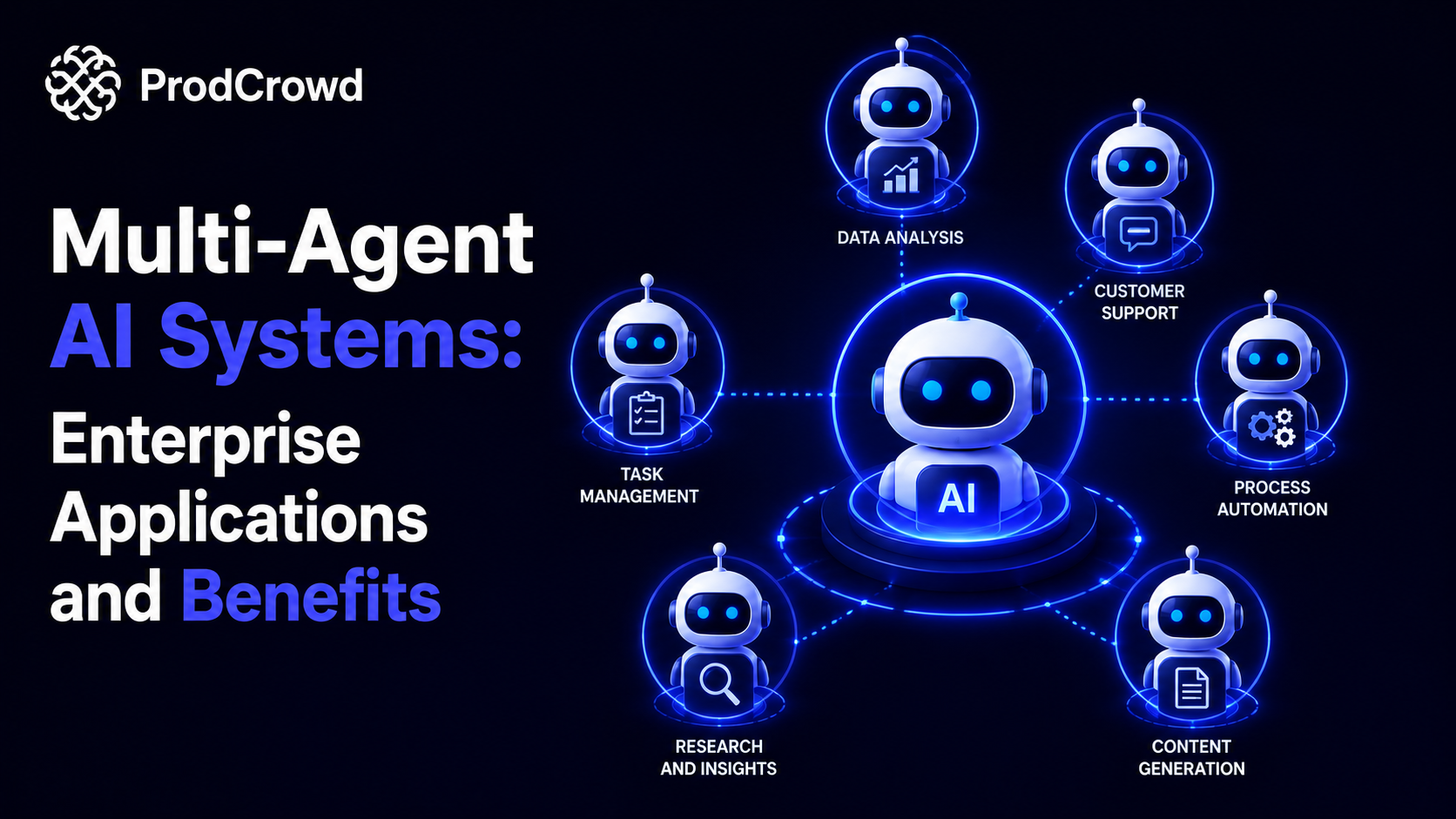
As businesses embrace artificial intelligence, a single AI assistant is often no longer enough to handle complex enterprise workflows. Modern organizations require multiple AI systems that can collaborate, communicate, and make decisions together across departments such as sales, customer support, operations, finance, HR, and IT.
This is where Multi-Agent AI Systems are transforming enterprise automation. Instead of relying on one AI model to perform every task, businesses deploy multiple specialized AI agents that work together to solve problems, automate workflows, analyze data, and improve operational efficiency.
In this guide, you’ll learn how Multi-Agent AI Systems work, why enterprises are adopting them, and how they deliver measurable business value in 2026.
Quick Answer
Multi-Agent AI Systems are networks of specialized AI agents that collaborate to complete complex business tasks. They improve enterprise productivity by automating workflows, sharing information, making coordinated decisions, and reducing manual effort across multiple business functions.
Key Takeaways
- Multiple AI agents collaborate to complete complex tasks.
- Improve enterprise productivity and operational efficiency.
- Automate cross-department workflows.
- Deliver faster and more accurate decision-making.
- Scale business operations without increasing workforce.
- Reduce operational costs while improving customer experience.
Table of Contents
- What Are Multi-Agent AI Systems?
- How Do Multi-Agent AI Systems Work?
- Why Are Enterprises Adopting Multi-Agent AI Systems?
- Single AI Agent vs Multi-Agent AI Systems
- Enterprise Applications
- Benefits for Businesses
- FAQs
- Conclusion
What Are Multi-Agent AI Systems?
Quick Answer
Multi-Agent AI Systems consist of multiple intelligent AI agents that work together to achieve a common objective. Each AI agent is responsible for a specific task, such as data analysis, customer support, workflow automation, or decision-making, while continuously communicating with other agents to complete larger business processes efficiently.
Unlike traditional AI systems, multi-agent architectures distribute responsibilities across specialized agents, making them more scalable, flexible, and capable of solving complex enterprise challenges.
Core Components of a Multi-Agent AI System
- Specialized AI Agents
- Central Orchestration Layer
- Shared Knowledge Base
- Workflow Automation Engine
- Communication Protocols
- Memory & Context Management
- APIs & Business Integrations
- Monitoring & Analytics
Together, these components enable enterprises to automate workflows that would otherwise require multiple human teams.
How Do Multi-Agent AI Systems Work?
Quick Answer
Multi-Agent AI Systems work by assigning different business tasks to specialized AI agents that collaborate through a central orchestration layer. Each agent performs its assigned role, exchanges information with other agents, and contributes to achieving a shared business objective.
Instead of one AI performing every function, multiple agents divide responsibilities, improving speed, accuracy, and scalability.
Typical Multi-Agent Workflow
- Receive user request or business event
- Assign tasks to specialized AI agents
- Retrieve enterprise data from connected systems
- Analyze information independently
- Share results between agents
- Coordinate decisions
- Execute automated workflows
- Monitor outcomes and continuously improve
For example, a customer inquiry could involve one AI agent retrieving CRM data, another generating a personalized response, and a third scheduling follow-up actions—all working together without human intervention.
Why Are Enterprises Adopting Multi-Agent AI Systems?
Quick Answer
Enterprises are adopting Multi-Agent AI Systems because they enable scalable automation, improve operational efficiency, reduce repetitive work, and support faster decision-making. By allowing specialized AI agents to collaborate, businesses can automate complex processes that span multiple departments.
As organizations grow, multi-agent architectures become increasingly valuable for managing large-scale operations.
Reasons Enterprises Are Investing in Multi-Agent AI
- Automate repetitive business processes
- Improve cross-functional collaboration
- Increase employee productivity
- Deliver faster customer support
- Enhance business intelligence
- Reduce operational costs
- Scale enterprise workflows
- Improve decision accuracy
- Enable 24/7 business automation
- Integrate seamlessly with existing enterprise software
Organizations implementing AI-driven automation are better equipped to respond quickly to changing market demands while maintaining operational excellence.
Single AI Agent vs Multi-Agent AI Systems
Quick Answer
A single AI agent is designed to handle individual tasks, while Multi-Agent AI Systems distribute responsibilities across multiple specialized agents that collaborate to solve complex enterprise challenges. This collaborative approach offers greater flexibility, scalability, and business efficiency.
| Single AI Agent | Multi-Agent AI Systems |
| Handles one primary task | Multiple specialized AI agents |
| Limited scalability | Highly scalable architecture |
| Centralized decision-making | Distributed intelligent decision-making |
| Suitable for simple automation | Ideal for enterprise workflows |
| Limited collaboration | Real-time agent collaboration |
| Easier to deploy | Better for complex business operations |
| Lower automation capability | End-to-end workflow automation |
| Basic business use cases | Enterprise-wide intelligent automation |
For organizations seeking to automate multiple departments and business functions, Multi-Agent AI Systems provide a more powerful and future-ready solution.
What Are the Enterprise Applications of Multi-Agent AI Systems?
Quick Answer
Multi-Agent AI Systems are transforming enterprise operations by automating complex workflows across departments. From customer support and sales to finance, HR, cybersecurity, and supply chain management, multiple AI agents collaborate to improve efficiency, reduce manual work, and accelerate decision-making.
Unlike traditional automation tools, multi-agent systems continuously share information and adapt to changing business conditions.
Enterprise Applications of Multi-Agent AI
- Customer Support Automation
- AI Sales Assistants
- Marketing Campaign Automation
- Supply Chain Optimization
- HR Recruitment & Employee Onboarding
- Financial Reporting & Analysis
- IT Operations & Help Desk Automation
- Cybersecurity Threat Detection
- Healthcare Workflow Management
- Manufacturing Process Optimization
Businesses using collaborative AI agents can automate end-to-end processes instead of isolated tasks, creating greater operational efficiency.
What Benefits Do Multi-Agent AI Systems Offer Businesses?
Quick Answer
Multi-Agent AI Systems help businesses improve productivity, reduce operational costs, accelerate decision-making, and deliver better customer experiences. By enabling specialized AI agents to work together, organizations can automate complex workflows while maintaining accuracy, scalability, and business continuity.
These systems allow employees to focus on strategic work while AI handles repetitive and time-consuming processes.
Key Business Benefits
- Higher operational efficiency
- Faster workflow execution
- Improved decision-making
- Reduced operational costs
- 24/7 business automation
- Better customer experiences
- Increased employee productivity
- Scalable enterprise operations
- Real-time business insights
- Seamless integration with existing systems
As enterprises grow, Multi-Agent AI Systems provide the flexibility needed to automate increasingly complex business operations without proportionally increasing workforce costs.
Why Choose ProdCrowd for Enterprise AI Solutions?
Quick Answer
ProdCrowd helps organizations design, develop, and deploy Multi-Agent AI Systems tailored to their business goals. Our AI experts build intelligent agent ecosystems that integrate with your existing software, automate enterprise workflows, and deliver measurable business outcomes.
Why Businesses Choose ProdCrowd
- Custom Multi-Agent AI Development
- Enterprise AI Strategy & Consulting
- AI Workflow Automation
- AI Agent Orchestration
- Generative AI Integration
- CRM & ERP Integrations
- Secure & Scalable AI Architecture
- Cloud-Based AI Deployment
- Ongoing Optimization & Support
- Industry-Specific AI Solutions
Whether you’re automating customer service, sales operations, internal workflows, or enterprise decision-making, ProdCrowd delivers AI solutions designed for long-term business growth.
Frequently Asked Questions
What are Multi-Agent AI Systems?
Multi-Agent AI Systems are collections of specialized AI agents that collaborate to complete complex tasks. Each agent performs a specific role while communicating with other agents to automate enterprise workflows efficiently.
How are Multi-Agent AI Systems different from a single AI agent?
A single AI agent handles one primary task, while Multi-Agent AI Systems coordinate multiple specialized agents to manage complex, cross-functional business processes with greater scalability and flexibility.
Which industries benefit most from Multi-Agent AI Systems?
Industries such as healthcare, manufacturing, finance, retail, logistics, insurance, SaaS, customer service, and e-commerce benefit significantly by automating operations, improving decision-making, and enhancing customer experiences.
Can Multi-Agent AI Systems integrate with existing business software?
Yes. Modern Multi-Agent AI Systems can integrate with CRM platforms, ERP systems, HR software, cloud applications, databases, APIs, and collaboration tools, allowing businesses to automate existing workflows without replacing their current infrastructure.
Why choose ProdCrowd for Multi-Agent AI development?
ProdCrowd provides end-to-end AI consulting, custom AI agent development, workflow automation, enterprise integrations, and ongoing optimization to help businesses successfully deploy scalable Multi-Agent AI Systems.
Ready to Build Enterprise AI That Scales?
Enterprise success today depends on intelligent automation. Multi-Agent AI Systems enable organizations to streamline operations, improve collaboration, and make faster, data-driven decisions across every department.
Partner with ProdCrowd to design and deploy custom Multi-Agent AI Systems that automate complex workflows, increase productivity, and accelerate digital transformation.
Conclusion
Multi-Agent AI Systems represent the next generation of enterprise automation. By combining multiple specialized AI agents into a collaborative ecosystem, businesses can automate complex workflows, improve operational efficiency, reduce costs, and make smarter decisions in real time. As AI adoption continues to grow in 2026, organizations investing in multi-agent architectures will be better positioned to scale operations, improve customer experiences, and gain a competitive advantage. With ProdCrowd as your AI partner, you can build secure, scalable, and future-ready AI systems tailored to your enterprise needs.