
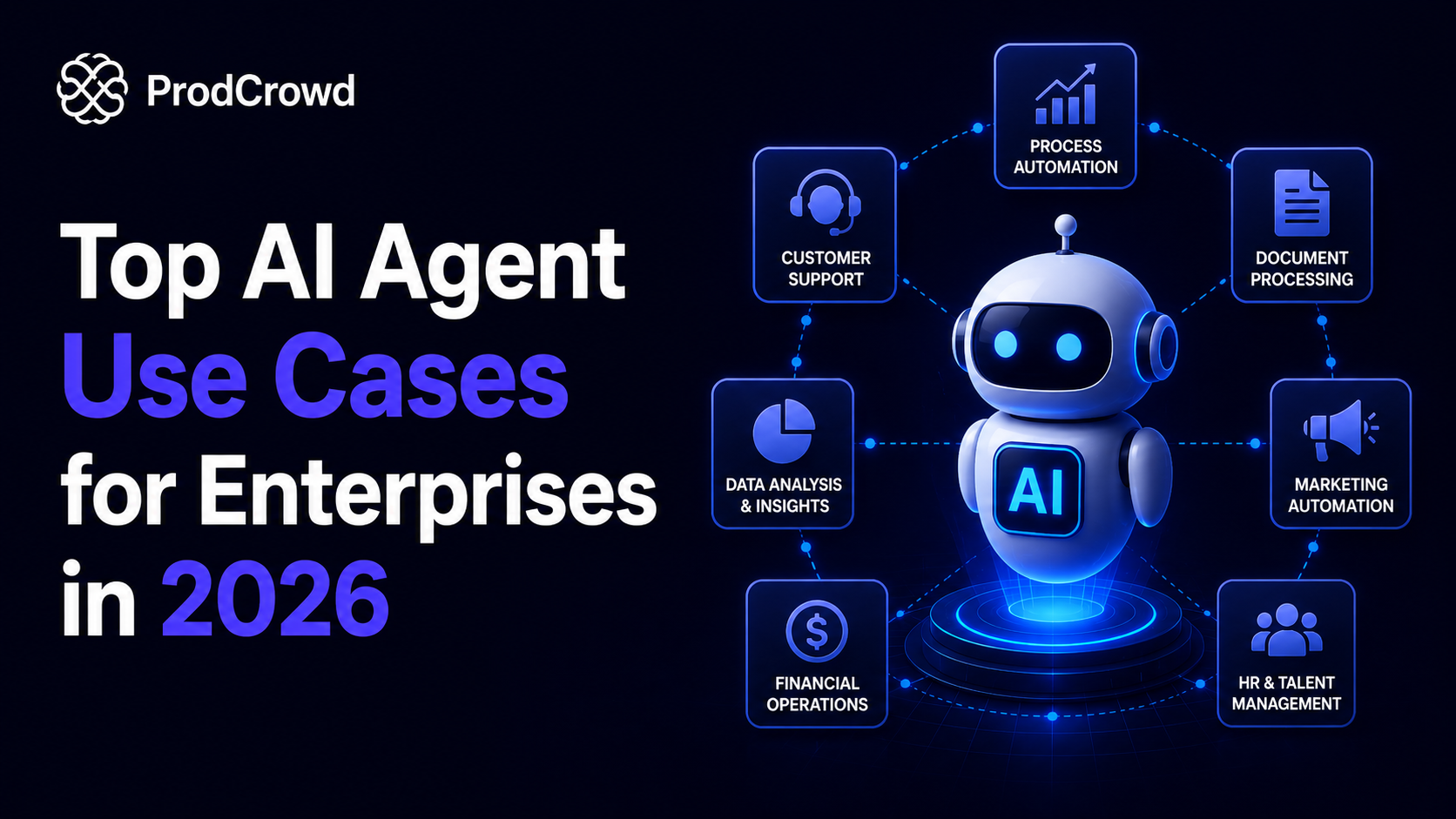
Enterprise AI has rapidly evolved beyond chatbots and simple automation tools. In 2026, businesses are deploying intelligent AI agents capable of understanding goals, making decisions, collaborating with other systems, and executing complex workflows with minimal human intervention. These AI agents are transforming how enterprises manage customer support, sales, finance, HR, IT operations, cybersecurity, and supply chain management.
Unlike traditional automation, AI agents combine Large Language Models (LLMs), machine learning, enterprise data, APIs, and business logic to complete multi-step tasks autonomously. They can analyze information, communicate naturally with users, retrieve data from multiple systems, and continuously improve through learning and feedback.
As organizations focus on productivity, cost reduction, and digital transformation, AI agents have become a strategic investment rather than an experimental technology. In this guide, we’ll explore the top AI agent use cases for enterprises in 2026, explain how they work, and highlight the business value they deliver across different industries.
Quick Answer
AI agents help enterprises automate complex business processes, improve customer experiences, reduce operational costs, and increase employee productivity. By integrating with CRM, ERP, HR, finance, and other enterprise systems, AI agents enable organizations to make faster decisions, streamline workflows, and scale operations efficiently.
Key Takeaways
- AI agents automate repetitive business processes.
- Enterprises reduce costs while improving productivity.
- AI agents support customer service, sales, HR, finance, and IT.
- Multi-agent systems automate end-to-end workflows.
- AI agents improve decision-making using real-time data.
- Businesses gain a competitive advantage through intelligent automation.
What Are AI Agents?
Quick Answer
AI agents are intelligent software systems that can understand goals, analyze information, make decisions, and complete tasks autonomously. Unlike traditional bots that follow predefined rules, AI agents use artificial intelligence, natural language processing (NLP), machine learning, and Large Language Models (LLMs) to adapt to changing situations and solve complex business problems.
AI agents can work independently or collaborate with other AI agents to execute complete business workflows.
Core Capabilities of AI Agents
- Natural language understanding
- Autonomous decision-making
- Workflow automation
- Multi-step task execution
- Context awareness
- Enterprise system integration
- Continuous learning
- Multi-agent collaboration
- Intelligent recommendations
- Real-time problem solving
These capabilities enable enterprises to automate business operations while maintaining flexibility, accuracy, and scalability.
Why Are Enterprises Investing in AI Agents?
Quick Answer
Enterprises are investing in AI agents because they improve operational efficiency, reduce manual workloads, accelerate digital transformation, and enhance customer experiences. AI agents help businesses automate repetitive tasks while allowing employees to focus on strategic initiatives that drive innovation and growth.
Organizations also benefit from faster decision-making, improved accuracy, and 24/7 operational support.
Key Business Benefits
- Increased employee productivity
- Lower operational costs
- Faster business processes
- Improved customer satisfaction
- Reduced manual errors
- Better data-driven decisions
- Continuous 24/7 operations
- Improved compliance
- Scalable automation
- Higher return on technology investment
As enterprise data continues to grow, AI agents help organizations transform information into actionable business insights.
How Do AI Agents Work in Enterprise Environments?
Quick Answer
AI agents operate by combining AI models, enterprise knowledge, APIs, business rules, and real-time data. They receive business objectives, analyze context, retrieve information from connected systems, make intelligent decisions, and execute tasks while continuously learning from outcomes.
Rather than performing isolated actions, AI agents can coordinate entire workflows across multiple business applications.
Typical Enterprise AI Workflow
- Receive a business request
- Understand user intent
- Access enterprise databases
- Retrieve relevant business information
- Analyze available options
- Make intelligent recommendations
- Execute approved actions
- Monitor outcomes
- Learn from interactions
- Continuously improve performance
This workflow enables AI agents to automate complex operations while maintaining accuracy, transparency, and compliance.
Traditional Automation vs AI Agents
Quick Answer
Traditional automation follows predefined rules and executes repetitive tasks. AI agents go beyond automation by understanding context, making decisions, adapting to changing situations, and completing complex workflows across multiple enterprise systems.
| Traditional Automation | AI Agents |
| Rule-based workflows | AI-driven decision making |
| Fixed instructions | Context-aware intelligence |
| Limited adaptability | Continuous learning |
| Manual workflow updates | Self-improving performance |
| Task-level automation | End-to-end workflow automation |
| Static responses | Personalized interactions |
| Limited integrations | Multi-system integration |
| Reactive operations | Proactive recommendations |
| Minimal collaboration | Multi-agent collaboration |
| Basic productivity gains | Enterprise-wide transformation |
For organizations seeking long-term digital transformation, AI agents provide significantly greater flexibility, intelligence, and business value than traditional automation tools.
Top AI Agent Use Cases for Enterprises in 2026
Quick Answer
AI agents are helping enterprises automate entire business operations by combining artificial intelligence, workflow automation, and enterprise data. They improve productivity, reduce operational costs, accelerate decision-making, and enable businesses to deliver exceptional customer and employee experiences.
Top AI Agent Use Cases for Enterprises
1. AI Customer Support Agents
AI agents provide instant customer support by answering questions, resolving issues, creating support tickets, retrieving customer information, and escalating complex requests to human representatives.
Benefits
- 24/7 customer support
- Faster response times
- Reduced support costs
- Higher customer satisfaction
2. AI Sales Assistants
Sales AI agents qualify leads, personalize outreach, schedule meetings, generate proposals, update CRM systems, and recommend next-best actions for sales teams.
Benefits
- Higher lead conversion
- Improved sales productivity
- Automated follow-ups
- Better pipeline management
3. AI Marketing Agents
Marketing agents generate content ideas, optimize SEO, personalize campaigns, analyze customer behavior, and automate omnichannel marketing.
Benefits
- Better customer engagement
- Higher campaign ROI
- Automated reporting
- Faster content production
4. AI HR & Recruitment Agents
HR agents screen resumes, schedule interviews, answer employee questions, manage onboarding, and assist with internal HR processes.
Benefits
- Faster hiring
- Better employee experience
- Reduced HR workload
- Improved compliance
5. AI Finance Agents
Finance AI agents automate invoice processing, reconciliation, budgeting, financial forecasting, compliance monitoring, and fraud detection.
Benefits
- Faster accounting
- Reduced manual errors
- Better financial visibility
- Improved compliance
6. AI IT Operations Agents
AI agents monitor infrastructure, detect issues, resolve incidents, reset passwords, create tickets, and automate routine IT operations.
Benefits
- Reduced downtime
- Faster incident resolution
- Improved system availability
- Lower IT support costs
7. AI Cybersecurity Agents
Security AI agents monitor enterprise networks, identify vulnerabilities, detect cyber threats, investigate anomalies, and automatically respond to incidents.
Benefits
- Real-time threat detection
- Faster response
- Reduced cyber risk
- Continuous monitoring
8. AI Supply Chain Agents
Supply chain AI agents optimize procurement, forecast demand, monitor inventory, predict shortages, and improve logistics planning.
Benefits
- Better inventory management
- Lower logistics costs
- Accurate forecasting
- Improved operational efficiency
9. AI Manufacturing Agents
Manufacturing AI agents monitor machines, optimize production schedules, predict maintenance, inspect quality, and reduce downtime.
Benefits
- Higher productivity
- Better quality control
- Predictive maintenance
- Reduced manufacturing costs
10. Executive Decision Agents
Executive AI agents consolidate enterprise data, generate dashboards, monitor KPIs, and provide strategic recommendations for leadership teams.
Benefits
- Faster reporting
- Better forecasting
- Improved business visibility
- Data-driven decisions
11. Multi-Agent Enterprise Systems
Modern enterprises increasingly deploy multiple specialized AI agents that collaborate to complete end-to-end business workflows. For example:
- Sales Agent qualifies a lead.
- Finance Agent prepares pricing.
- Legal Agent reviews contracts.
- Customer Success Agent manages onboarding.
- Support Agent provides post-sales assistance.
This coordinated approach delivers intelligent enterprise-wide automation.
Benefits
- Cross-functional automation
- Faster operations
- Improved collaboration
- Enterprise scalability
- Lower operating costs
Why Choose ProdCrowd?
Quick Answer
ProdCrowd specializes in designing and developing enterprise-grade AI agents tailored to your business goals. We help organizations automate workflows, integrate AI with existing systems, and build scalable multi-agent ecosystems that deliver measurable business outcomes.
Our Expertise
- Custom AI Agent Development
- Multi-Agent Architecture
- Enterprise AI Consulting
- Workflow Automation
- Generative AI Solutions
- CRM & ERP Integration
- API Development
- Cloud Deployment
- AI Optimization
- Ongoing Support
Frequently Asked Questions
What industries benefit most from AI agents?
AI agents are widely used in healthcare, finance, manufacturing, retail, logistics, insurance, education, SaaS, telecommunications, and professional services.
Can AI agents replace employees?
No. AI agents automate repetitive and time-consuming tasks, allowing employees to focus on strategic work, creativity, and customer relationships.
How long does it take to build an enterprise AI agent?
Development timelines vary depending on complexity, integrations, and customization, but a basic enterprise AI agent can often be deployed in a few weeks, while advanced multi-agent systems require a more extensive implementation.
Are enterprise AI agents secure?
Yes. When implemented correctly, AI agents can include enterprise-grade security features such as role-based access control, encryption, audit logs, and compliance with industry standards.
Why choose ProdCrowd for AI agent development?
ProdCrowd combines AI expertise, enterprise integration capabilities, and scalable architecture to deliver secure, high-performance AI solutions that align with your business objectives.
Ready to Transform Your Enterprise?
AI agents are becoming the backbone of modern enterprise operations. Businesses that adopt intelligent automation today will gain a competitive advantage through faster processes, lower costs, improved customer experiences, and smarter decision-making.
Contact ProdCrowd today to build custom AI agents and multi-agent systems that transform the way your business operates.
Conclusion
The top AI agent use cases for enterprises in 2026 include customer support, sales, marketing, HR, finance, IT, cybersecurity, manufacturing, supply chain management, and executive decision-making. As AI technology continues to evolve, enterprises that invest in intelligent agents will be better equipped to automate operations, improve productivity, and accelerate innovation. With ProdCrowd’s expertise in enterprise AI development, organizations can implement scalable, secure, and future-ready AI solutions that deliver measurable business value.