
Generative AI has become a strategic priority for enterprises looking to improve productivity, customer experience, and decision-making. However, many organizations quickly discover that traditional Large Language Models (LLMs) have limitations. They may generate outdated information, produce inaccurate responses (hallucinations), or lack access to company-specific knowledge.
This is where Retrieval-Augmented Generation (RAG) transforms enterprise AI. Instead of relying only on the knowledge stored within a language model, RAG retrieves relevant information from trusted business data sources—such as internal documents, knowledge bases, databases, CRMs, SharePoint, cloud storage, or enterprise applications—before generating a response.
For business leaders, RAG is not simply another AI technology; it is a practical way to build secure, reliable, and enterprise-ready AI assistants without retraining expensive foundation models. Whether you’re planning an AI-powered customer support platform, internal knowledge assistant, legal document search, or enterprise AI agent, understanding RAG architecture is essential for making informed technology investments.
In this guide, we’ll explain RAG Architecture in simple business terms, explore how it works, compare it with traditional LLMs, and discuss why it has become the preferred architecture for enterprise AI solutions in 2026.
Quick Answer
Retrieval-Augmented Generation (RAG) combines a Large Language Model with real-time information retrieval from trusted enterprise data sources. Instead of relying only on pre-trained knowledge, RAG searches company documents and databases before generating responses, making enterprise AI more accurate, secure, explainable, and scalable.
Key Takeaways
- RAG reduces AI hallucinations.
- Uses real-time enterprise knowledge.
- Improves response accuracy.
- Protects sensitive business information.
- Eliminates frequent model retraining.
- Powers enterprise AI assistants and AI agents.
Table of Contents
- What Is RAG (Retrieval-Augmented Generation)?
- Why Should Business Decision Makers Care About RAG?
- How Does RAG Architecture Work?
- Traditional LLM vs RAG Architecture
- Business Benefits of RAG
- Enterprise RAG Use Cases
- FAQs
- Conclusion
What Is RAG (Retrieval-Augmented Generation)?
Quick Answer
Retrieval-Augmented Generation (RAG) is an AI architecture that combines a Large Language Model (LLM) with an intelligent retrieval system. Before generating an answer, the AI searches trusted enterprise data sources for relevant information, ensuring responses are based on the latest business knowledge rather than only the model’s pre-trained data.
Think of RAG as giving your AI assistant access to your company’s internal knowledge library before it answers a question.
Core Components of RAG
- Large Language Model (LLM)
- Document Repository
- Knowledge Base
- Vector Database
- Embedding Model
- Retrieval Engine
- Prompt Builder
- AI Response Generator
Together, these components enable AI systems to deliver responses that are both conversational and grounded in verified enterprise information.
Why Should Business Decision Makers Care About RAG?
Quick Answer
Business leaders should care about RAG architecture because it makes enterprise AI significantly more reliable, secure, and practical. Instead of generating answers based only on general internet knowledge or outdated training data, RAG uses your organization’s approved documents and data sources to provide trustworthy responses.
For enterprises, this means lower risk, higher accuracy, and faster access to critical business information.
Business Advantages
- More accurate AI responses
- Reduced AI hallucinations
- Faster employee access to knowledge
- Better customer support
- Improved regulatory compliance
- Lower AI implementation costs
- Higher employee productivity
- Secure use of enterprise data
- Faster business decisions
- Scalable enterprise AI deployment
Rather than replacing existing business systems, RAG enhances them by making enterprise knowledge instantly searchable and actionable.
How Does RAG Architecture Work?
Quick Answer
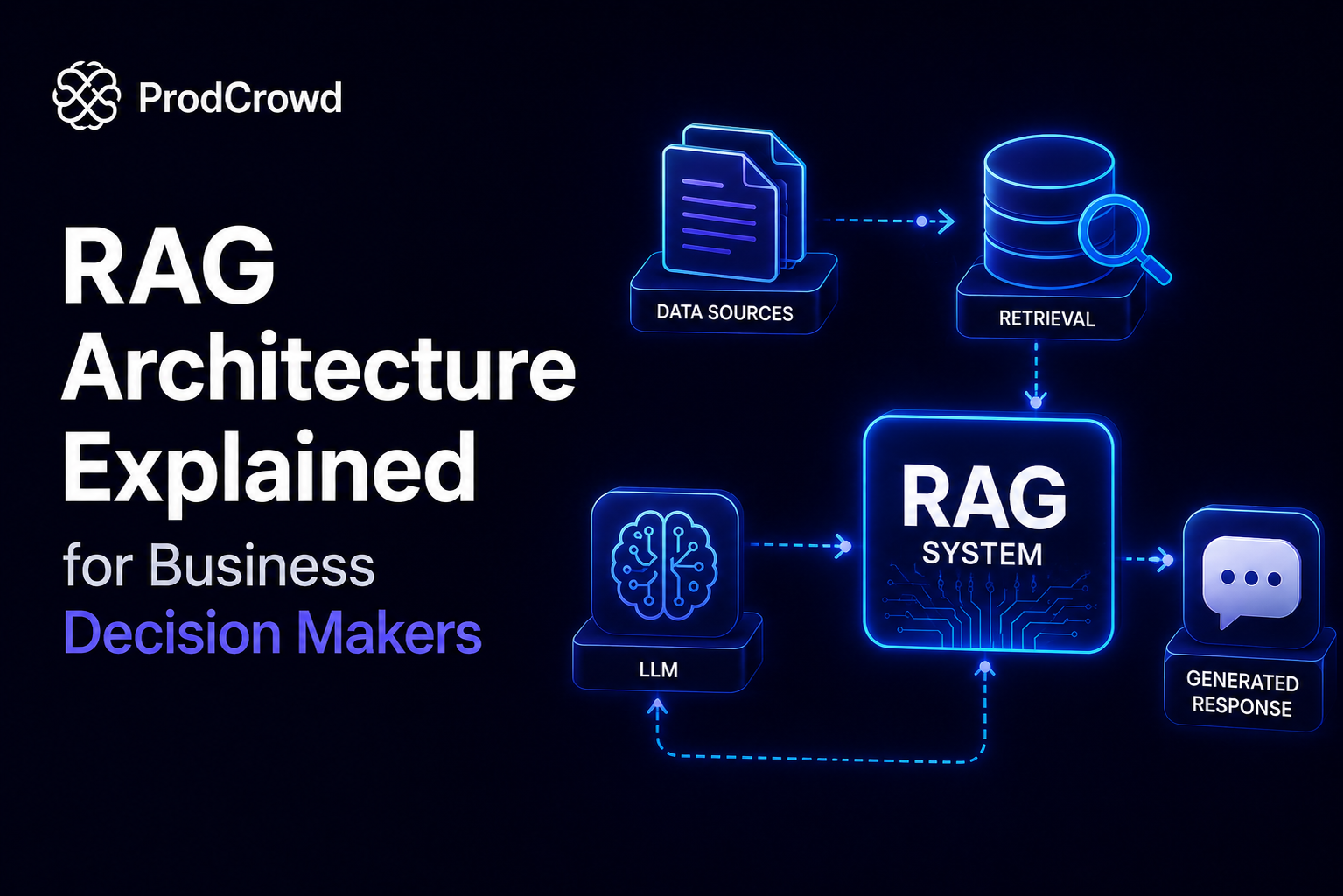
RAG architecture follows a simple but powerful workflow. When a user asks a question, the system first searches trusted enterprise knowledge sources, retrieves the most relevant information, and then provides that context to the Large Language Model. The LLM uses this retrieved information to generate a more accurate, relevant, and explainable response.
Step-by-Step RAG Workflow
- User submits a question.
- The query is converted into vector embeddings.
- The retrieval engine searches the vector database.
- Relevant documents are retrieved.
- Retrieved context is combined with the user’s query.
- The Large Language Model generates a response.
- The AI provides an answer based on verified business information.
Typical Enterprise Data Sources
- Company knowledge bases
- SharePoint
- CRM platforms
- ERP systems
- Internal documents
- Product manuals
- Standard Operating Procedures (SOPs)
- Policy documents
- Cloud storage
- Customer support documentation
This approach enables AI assistants to answer questions using current, organization-specific information instead of relying solely on static training data.
Traditional LLM vs RAG Architecture
Quick Answer
Traditional LLMs rely primarily on information learned during training, while RAG architecture retrieves up-to-date enterprise knowledge before generating responses. As a result, RAG provides more accurate, transparent, and business-specific answers, making it the preferred choice for enterprise AI applications.
| Traditional LLM | RAG Architecture |
| Uses pre-trained knowledge | Retrieves real-time enterprise data |
| Limited knowledge updates | Continuously uses latest business information |
| Higher risk of hallucinations | Reduced hallucinations through grounded responses |
| Difficult to customize | Easily connects to enterprise knowledge bases |
| Requires expensive model retraining | Updates knowledge without retraining |
| Limited source transparency | Responses can reference retrieved documents |
| Less suitable for regulated industries | Better suited for compliance-focused businesses |
| General-purpose AI | Enterprise-ready AI architecture |
| Limited personalization | Context-aware enterprise responses |
| Higher long-term maintenance | More scalable knowledge management |
For organizations planning AI adoption in 2026, RAG provides a practical balance between the conversational capabilities of Large Language Models and the reliability of trusted enterprise data.
Business Benefits of RAG Architecture
Quick Answer
RAG architecture helps enterprises build AI systems that are more accurate, trustworthy, and scalable. By retrieving verified information from internal business data before generating responses, organizations can improve decision-making, reduce operational risks, and maximize the value of their existing knowledge assets.
Unlike standalone Large Language Models, RAG delivers business-ready AI that evolves as your organization’s data grows.
1. More Accurate AI Responses
RAG retrieves information directly from your enterprise knowledge base before generating an answer, significantly improving response accuracy.
Business Benefits
- Reduced misinformation
- Better customer responses
- Reliable internal knowledge
- Improved employee confidence
2. Reduced AI Hallucinations
One of the biggest concerns with enterprise AI is hallucination—when AI confidently generates incorrect information. RAG minimizes this by grounding responses in verified business content.
Business Benefits
- Lower business risk
- More trustworthy AI
- Better compliance
- Improved decision-making
3. Real-Time Knowledge Access
Business information changes constantly. Policies, pricing, documentation, and product information are updated regularly. RAG enables AI to access the latest information without retraining the underlying model.
Business Benefits
- Always up-to-date answers
- Faster knowledge sharing
- Better operational efficiency
- Reduced maintenance effort
4. Better Data Security
RAG allows enterprises to use private business data without permanently embedding sensitive information into an AI model.
Business Benefits
- Secure enterprise deployments
- Better access control
- Protection of confidential information
- Easier governance
5. Lower AI Implementation Costs
Instead of repeatedly retraining expensive language models, businesses simply update their knowledge base while keeping the AI system current.
Business Benefits
- Reduced infrastructure costs
- Faster deployment
- Easier maintenance
- Higher long-term ROI
6. Improved Employee Productivity
Employees spend less time searching for documents and more time completing valuable work.
Business Benefits
- Faster onboarding
- Instant knowledge access
- Improved collaboration
- Better operational efficiency
Common Enterprise RAG Use Cases
Quick Answer
RAG architecture can be applied across nearly every enterprise department. By combining AI with organization-specific knowledge, businesses can automate information retrieval, improve customer service, and streamline internal operations while maintaining accuracy and compliance.
Customer Support Knowledge Assistant
Provide instant answers using:
- Product manuals
- Troubleshooting guides
- FAQs
- Support documentation
- Warranty information
Enterprise Knowledge Management
Help employees quickly find information from:
- SOPs
- Internal documentation
- HR policies
- Training manuals
- Company knowledge bases
Sales Enablement
Sales teams can instantly access:
- Product specifications
- Pricing documents
- Case studies
- Proposal templates
- Competitive comparisons
Legal Document Assistant
Legal teams can search and analyze:
- Contracts
- Compliance documents
- Policies
- Regulations
- Internal legal knowledge
HR Assistant
Employees can ask questions about:
- Leave policies
- Benefits
- Payroll
- Company procedures
- Onboarding documentation
IT Help Desk
Provide automated assistance using:
- Technical documentation
- System guides
- Troubleshooting workflows
- Infrastructure knowledge
- Security procedures
Executive Business Intelligence
Executives gain instant access to:
- Business reports
- Operational dashboards
- KPI summaries
- Strategic documents
- Market intelligence
Multi-Agent Enterprise AI
Modern enterprises increasingly combine RAG with AI agents. Multiple specialized agents retrieve relevant business knowledge before collaborating to complete complex workflows such as procurement, finance approvals, customer onboarding, and internal support.
Why Choose ProdCrowd for RAG Development?
Quick Answer
ProdCrowd designs enterprise-grade RAG (Retrieval-Augmented Generation) solutions that integrate seamlessly with your existing business systems. Our RAG architectures are built for scalability, security, and performance, enabling organizations to deploy AI assistants and AI agents that deliver accurate, context-aware responses using trusted enterprise knowledge.
Why Enterprises Choose ProdCrowd
- Enterprise RAG Architecture Design
- Custom AI Knowledge Bases
- AI Agent Development
- Vector Database Implementation
- LLM Integration
- Secure Enterprise Deployments
- CRM & ERP Integration
- API Development
- AI Workflow Automation
- Ongoing Monitoring & Optimization
Whether you’re building an internal knowledge assistant, customer support AI, legal research platform, or enterprise AI agent, ProdCrowd provides end-to-end RAG implementation tailored to your business goals.
Frequently Asked Questions
What is RAG architecture in AI?
RAG (Retrieval-Augmented Generation) is an AI architecture that combines a Large Language Model with a retrieval system that searches trusted enterprise knowledge before generating responses, improving accuracy and relevance.
Why is RAG better than a traditional LLM?
Traditional LLMs rely only on their training data, while RAG retrieves current information from enterprise knowledge sources, reducing hallucinations and providing more reliable answers.
Does RAG require retraining an AI model?
No. One of the biggest advantages of RAG is that businesses can update their knowledge base without retraining the underlying language model.
Which industries benefit from RAG architecture?
RAG is widely used in healthcare, finance, legal services, manufacturing, retail, SaaS, education, insurance, government, and customer support—any industry that depends on accurate, up-to-date information.
Why should businesses choose ProdCrowd for RAG development?
ProdCrowd combines expertise in Generative AI, enterprise integrations, vector databases, AI agents, and workflow automation to build secure, scalable RAG solutions that deliver measurable business value.
Ready to Build Enterprise AI with RAG?
Enterprise AI is most valuable when it delivers responses your teams and customers can trust. RAG architecture provides the accuracy, scalability, and security needed to transform business knowledge into intelligent, actionable insights.
Contact ProdCrowd today to design and deploy a custom RAG-powered AI solution that integrates with your enterprise systems and accelerates digital transformation.
Conclusion
RAG Architecture has become the foundation of enterprise Generative AI because it combines the conversational intelligence of Large Language Models with the reliability of real-time business knowledge. Instead of relying solely on static training data, RAG enables organizations to build AI systems that are more accurate, secure, explainable, and scalable. Whether supporting customer service, internal knowledge management, legal research, HR, or executive decision-making, RAG empowers enterprises to unlock greater value from their data. With ProdCrowd as your AI technology partner, businesses can implement enterprise-ready RAG solutions that improve productivity, strengthen governance, and deliver long-term competitive advantage.